
Hall III, Rugs and TextilesLooped wool5 min read
Bouclé, Understood
Why the looped yarn returned to the salon, and how to live with it beautifully.
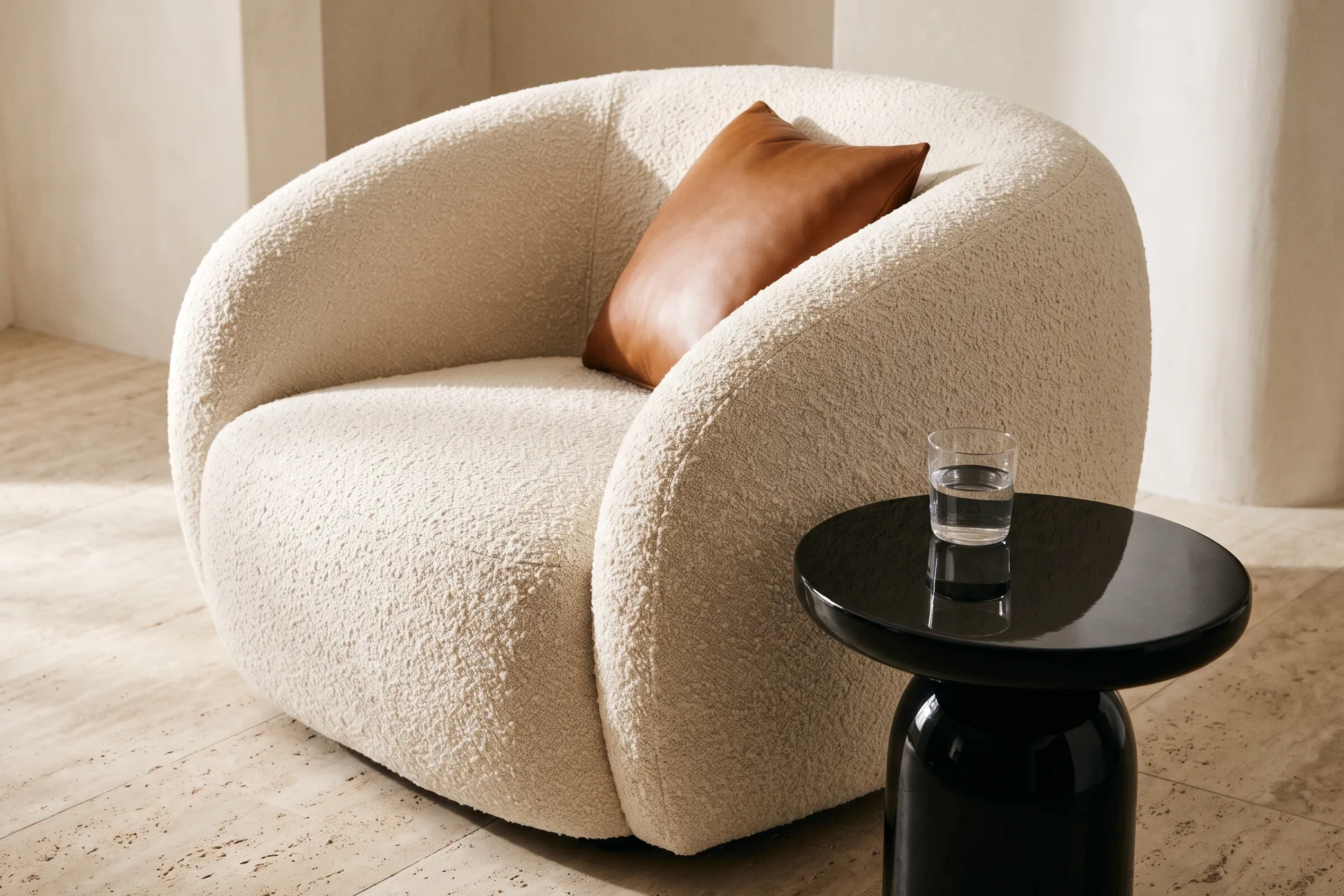
A rounded armchair stands in a pool of afternoon light, its surface a landscape of tiny loops, each catching a glint and casting a shadow no larger than a grain of rice. You want to touch it before you sit. That is bouclé, the looped fabric that has found its way back into the salon. This guide explains how it is made, why it suits curved furniture so well and how to live with it beautifully.
At a glance
- The name bouclé comes from the French boucler, which means to curl.
- Bouclé yarn is plied so that one strand forms small loops along its length.
- Its looped surface scatters light softly, hides small marks and pairs well with smooth materials.
- Vacuum with a soft brush, never pull a snagged loop and check the Martindale count.
A yarn that curls
The name comes from the French boucler, to curl. Bouclé is first of all a yarn: several strands are plied together, but one of them is fed in faster or more loosely than the others, so that its excess gathers into small loops along the length. A fine binding thread holds the loops in place. Woven or knitted, the yarn becomes a fabric with a nubbly, softly irregular surface.
The size of the loops shapes the character. Tight, small loops give a fine, almost granular texture that reads calmly from across a room; large, open loops make a bold, cloud-like surface that invites the hand. Between the two lie many variations, from discreet textured weaves to generous looped surfaces.
Bouclé can be spun from many fibres, and each gives it a different hand.
- Wool: springy, warm and resilient, the classic choice for upholstery
- Alpaca: soft, light and silky, with a gentle sheen
- Mohair: lustrous and strong, with a subtle halo
- Cotton: matt and cool, well suited to warmer climates
- Blends: wool with cotton, linen or other fibres for added strength
Bouclé differs from terry, the fabric of towels, whose loops are formed by an extra set of warp threads during weaving. In bouclé the loops live in the yarn itself, which is why its surface feels drier, denser and more sculptural.
From tailoring to the salon
Through the twentieth century, bouclé appeared both in upholstery and in fashion, where tailored jackets in looped wool became a lasting classic. Its texture gave structure without stiffness and warmth without weight, qualities that suited furniture as well as clothing.
In recent years it has returned to living rooms, often on rounded sofas, curved armchairs and soft ottomans. Bouclé suits these forms naturally: its texture follows a curve without drawing attention to seams, and the loops soften the silhouette further, so that a piece looks almost carved from a single cloud of wool.
On a straight-lined piece, bouclé brings warmth to architecture; on a curved one, it becomes part of the form itself. In both cases it adds something that photographs rarely capture: a quiet invitation to touch.
Why bouclé works
Texture changes the way a fabric meets light. The countless loops of bouclé scatter light softly instead of reflecting it, so the colour reads gentle and even, and every loop casts a tiny shadow that gives the surface depth. For the same reason bouclé is forgiving: small marks and the faint impressions of daily life vanish into the texture.
Its hand is warm and springy, especially in wool, and it pairs beautifully with smooth materials. Set a bouclé armchair beside a lacquered side table, on honed stone or next to polished wood, and each material makes the other more vivid. Leather and bouclé together, the smooth and the curly, form one of the most satisfying contrasts in upholstery.
Colour completes the effect. Ivory, oatmeal and chalk white show the texture most clearly and suit calm, light rooms; deeper tones such as tobacco, moss or charcoal give bouclé a more tailored, wintry character, lovely in a library or beside a fire.
Bouclé turns light into texture, and texture into an invitation.
Bouclé in the room
Bouclé is most persuasive in measured doses. A pair of rounded armchairs by a window, a single sofa in a room of smooth plaster and wood, or a bench at the foot of a bed lets the texture be the one soft note in a composition. Where everything is looped, the eye loses the contrast that makes it special.
Think about light as well. Bouclé looks its richest where light falls across it from the side, from a window or a low lamp, because then every loop casts its small shadow. Under even overhead light it becomes calmer and paler, which suits a quiet bedroom or a reading corner.
Living with it beautifully
For seating in daily use, ask about abrasion resistance. The Martindale rub test counts the cycles a fabric withstands before showing wear, and a higher count suits family rooms. Tightly woven bouclé with smaller loops usually wears best on seats, while very open, large-looped weaves are lovely on occasional chairs, cushions and headboards.
Care is simple. Vacuum gently with a soft brush attachment to lift dust from between the loops. Blot spills at once with a clean, dry cloth, without rubbing, which can distort the loops. For deeper cleaning, entrust the piece to a professional upholstery cleaner.
If a loop catches, never pull it. Ease it back into the fabric from the reverse with a blunt needle where you can, or trim it carefully level with the surface using small, sharp scissors. A pulled loop can draw a whole row of yarn with it, while a trimmed one disappears into the texture.
Bouclé rewards a slow look and a light touch. In morning light it is soft and pale, in lamplight it becomes a field of small shadows, and over the years it settles gently without losing its curl. Few fabrics make a room feel warm so instantly, or so quietly.
Questions and answers
What is bouclé?
Bouclé is a fabric woven or knitted from bouclé yarn, in which one strand is plied so that it forms small loops. The result is a nubbly, softly textured surface. The name comes from the French boucler, to curl, and the fabric is made in wool, alpaca, mohair, cotton and blends.
Is bouclé suitable for a sofa in daily use?
Yes, when you choose it with care. Ask about the Martindale abrasion count, which shows how many rubbing cycles a fabric withstands, and prefer tightly woven bouclé with smaller loops for seats in daily use. Very open, large loops are lovely on cushions, headboards and occasional chairs.
What should I do if a bouclé loop snags?
Never pull a snagged loop, because it can draw a whole row of yarn with it. Ease it back into the fabric from the reverse with a blunt needle where possible, or trim it carefully level with the surface using small, sharp scissors. The repair then disappears into the texture.
Terms in this article
- Bouclé yarn
- A plied yarn in which one strand is fed in more loosely than the others, so that it forms small loops.
- Plying
- Twisting two or more strands of yarn together to make a single, stronger thread.
- Martindale rub test
- A test that measures the abrasion resistance of a fabric by counting the rubbing cycles it withstands before showing wear.
Filed undertextilesboucleupholsterytexturecare


