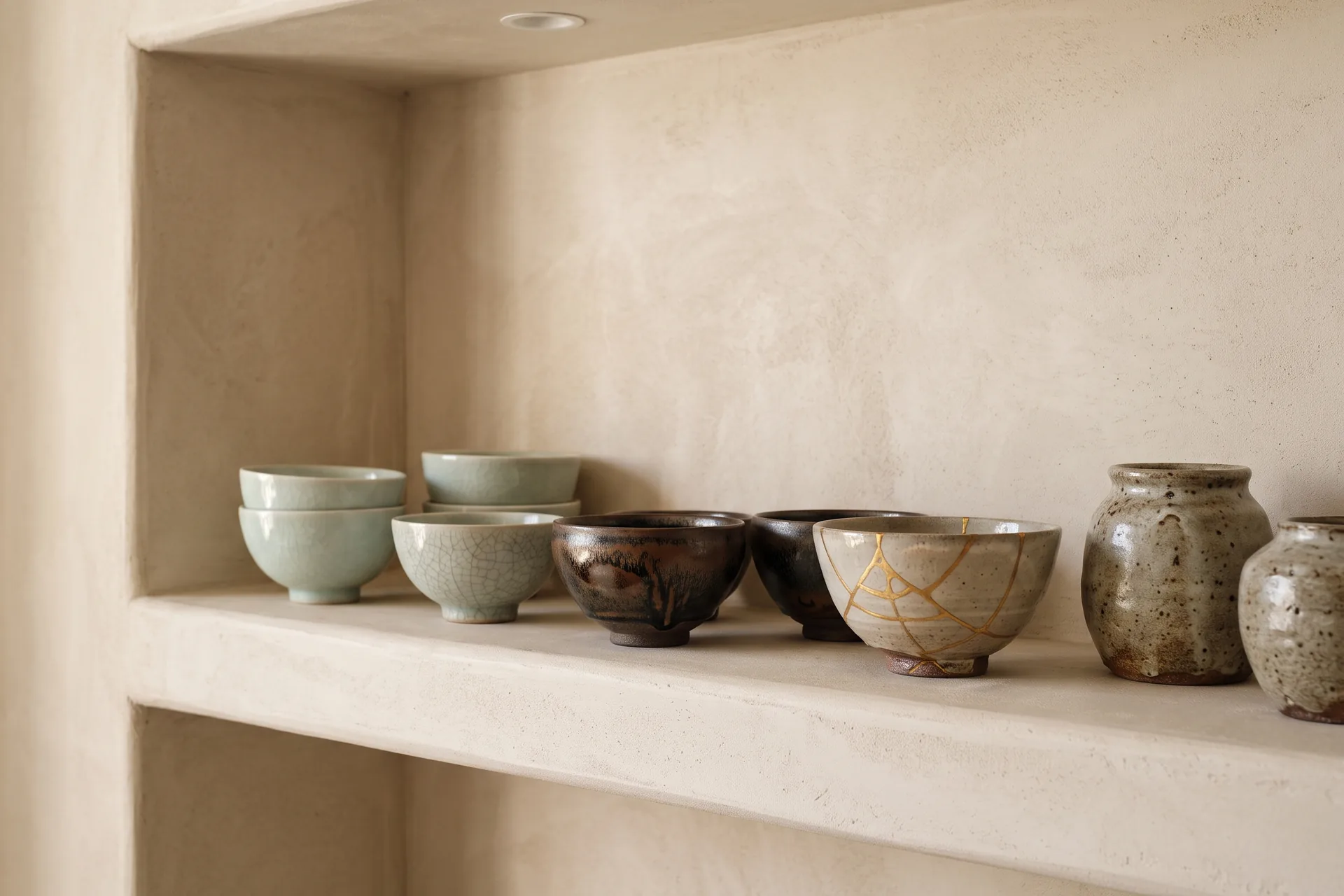

Hall VIStoneware and glaze5 min read
The Language of Studio Ceramics
Stoneware, porcelain, celadon and raku: reading clay and glaze, and displaying ceramics with grace.
Tools06
The language of interiors is rich and occasionally obscure. The glossary explains the materials, techniques and terms you meet in our articles and in the galleries, in plain and exact words.
A fine-grained, translucent stone, in the decorative arts usually a form of gypsum, soft enough to be carved and turned by hand. Lit from within, it glows with a warm, milky light, which makes it a natural material for lamps.
The decorative style that flourished in the 1920s and 1930s, named after the 1925 Paris Exposition internationale des Arts décoratifs et industriels modernes. It pairs geometry and sunbursts with lacquer, exotic veneers, shagreen and mirrored glass.
The school of art, design and architecture founded by Walter Gropius in Weimar in 1919, which later moved to Dessau and Berlin and existed until 1933. Its name stands for functional form, unornamented surfaces, tubular steel and the meeting of craft and industry.
The angle of the cone of light a lamp or spotlight emits, usually measured where the intensity falls to half its central value. Narrow beams pick out small objects, wide beams wash walls and large canvases.
Opening consecutive slabs of stone or leaves of veneer, cut from the same block or log, like the pages of a book, so that the veining or grain mirrors itself across the joint.
A fabric woven from bouclé yarn, in which one strand is plied so that it forms small loops, giving a nubbly, softly textured surface. The name comes from the French boucler, to curl.
A rounded outgrowth on a tree trunk or root, called burr in Britain, whose tightly swirling grain is full of small knots and eyes. Cut into veneer, walnut and amboyna burl give furniture a richly figured surface.
A family of glazes in shades from jade green to blue-grey, coloured by small amounts of iron and fired in a kiln starved of oxygen. Celadon originated in China and became a treasured tradition in Korea and Japan as well.
A sofa with deep-buttoned upholstery whose arms and back run at the same height, usually with rolled arms. The form became popular in nineteenth-century Britain and is traditionally covered in leather.
A scale up to 100 that describes how faithfully a light source shows the colours of objects compared with a reference light. Values of 90 or more render wood, stone, textiles and skin naturally.
A written account of the state of an object at a given moment, noting wear, damage, restorations and replaced parts, usually with photographs. Collectors ask for one before buying and keep it with the documentation.
A projecting moulding along the top of a wall where it meets the ceiling, or crowning a cabinet or a building. Inside a room it frames the ceiling and can conceal curtain tracks or indirect light.
A flatwoven rug from India without pile, traditionally of cotton and also made in wool. Dhurries are light, often reversible and easy to move from room to room.
A quality of some LED lamps that turn warmer in colour as they are dimmed, moving from warm white towards the amber of candlelight, much as an incandescent bulb does when it is turned down.
A woodworking joint of interlocking, fan-shaped tails and pins that resists being pulled apart in one direction. Cut by hand, it is a traditional sign of careful cabinetmaking, especially at the corners of drawers.
A suite of rooms whose doorways are aligned on one axis, so that a single view runs through the whole sequence, as in Baroque palaces. In French the word also names a long, low sideboard with several doors.
A traditional finish in which shellac dissolved in alcohol is applied in many thin coats with a cloth pad, the rubber, in small circular movements, building a deep, glassy shine that shows the figure of the wood.
From the Italian for outside the Salone: the programme of exhibitions, installations and open showrooms that spreads across Milan during the Salone del Mobile, gathered in districts such as Brera and Tortona.
A smooth white ground of chalk or gypsum bound with animal glue, built up on wood in many thin layers. Once dry and smoothed, it can be carved and forms the base for water gilding and for painting on panel.
The craft of applying gold leaf or other metal leaf to a surface. Water gilding is laid on gesso and bole and can be burnished to a mirror shine, while oil gilding is laid on an oil size and stays softly matt.
A warm, very humid steam bath of the Middle East and North Africa, often called a Turkish bath, that continues the bathing culture of Roman and Byzantine baths. Marble benches and a domed ceiling are typical.
Describes a rug made knot by knot on the vertical warps of a loom: each knot is usually tied around two warp threads and cut to form the pile, and rows of weft lock every line in place.
Describes a rug made by punching yarn through a backing cloth stretched on a frame with a hand-held tufting tool, then securing it with an adhesive and a second backing. The method is quick and allows free, painterly designs.
A smooth, matt stone surface produced by grinding without the final polish. Honed marble, travertine and limestone show their colour softly and without reflection, and give good grip on bathroom floors.
A soft, thick layer, often of cotton flannel known as bump, sewn between curtain fabric and lining. It gives drapery body and fuller folds and adds insulation against cold and sound.
A contemporary blend of Japanese and Scandinavian design, joined by restraint, natural materials and craft: oak and ash, paper, linen and stoneware, low furniture, warm neutral colours and generous space around a few objects.
The European imitation of Asian lacquer, developed in the seventeenth and eighteenth centuries with layers of varnish, often black or red, decorated with gilded chinoiserie scenes on furniture, boxes and panels.
The unit used to describe the colour temperature of white light. Around 2700 K reads as warm, like a traditional incandescent bulb, about 4000 K as neutral white, and daylight lies roughly between 5000 and 6500 K.
A flatwoven rug without pile, made in slit tapestry weave: wefts of each colour turn back where the colours meet and leave small vertical slits. Kilims are woven across a wide belt from the Balkans through Anatolia to Central Asia.
The Japanese art of repairing broken ceramics with urushi lacquer dusted with powdered gold or other metals, so that the mended cracks become visible lines that honour the history of the object.
The number of knots in a given area of a hand-knotted rug, counted per square decimetre or, traditionally, per square inch. Denser knotting allows finer, more detailed drawing, while a lower count suits bold patterns.
A hard, glossy coating built up in thin coats. Asian lacquer comes from the sap of the lacquer tree and cures slowly in warm, humid air, while modern furniture lacquers are synthetic finishes that give a durable gloss.
The long annealing oven of a glassworks, in which finished pieces cool slowly and evenly over many hours so that internal stresses are released and the glass becomes stable.
A sedimentary rock formed largely of calcium carbonate, often from the shells of marine organisms. Its colours are usually calm and even, from cream to grey, and it is valued for floors, walls and carved basins.
A traditional paint of slaked lime and water, often tinted with natural pigments. It bonds with mineral surfaces such as plaster and stone and dries to a soft, chalky finish with gentle, cloudy movement.
A design produced in a fixed number of examples announced in advance, each usually numbered and signed, as in 3 of 8. Prototypes and artist’s proofs are sometimes made in addition to the edition.
A textile woven from the fibres of the flax plant. Strong, cool to the touch and absorbent, it creases naturally, softens with every wash and is one of the oldest textiles, known from ancient Egypt.
The Finnish word for the burst of steam that rises when water is ladled onto the hot stones of a sauna stove, and for the soft, enveloping heat it brings to the room.
The unit of luminous flux, describing how much visible light a source emits in all directions. On a lamp it indicates brightness, whereas watts describe the energy the lamp uses.
The unit of illuminance: one lumen falling on one square metre. It describes how much light arrives on a surface; around 500 lux on a reading page or kitchen worktop is a widely used guide at home.
A dense tropical hardwood from Sulawesi in Indonesia, boldly striped in black and warm brown. Cut into veneer, it became one of the defining materials of French Art Deco cabinetmaking.
Japanese for sprinkled picture: a lacquer technique in which gold or silver powder is sprinkled onto a design drawn in wet urushi, then fixed, polished and often built up in several layers.
A metamorphic rock of recrystallised calcite or dolomite, prized since antiquity for its veining and luminous depth. It takes a high polish or a soft honed finish and is best cared for with pH-neutral cleaners.
A Venetian lime plaster made with fine marble powder, applied with a trowel in thin layers and compacted to a finish that ranges from soft matt to a silky sheen.
Decoration made from thin veneers of different woods, and sometimes brass, bone or mother-of-pearl, cut and fitted together like a puzzle and glued to a carcass to form pictures or ornament.
A widely used abrasion test for upholstery fabrics, in which a sample is rubbed against a standard cloth in a figure-of-eight motion until it shows wear. Results are given in rubs; higher counts suit sofas in daily family use.
The design of roughly 1945 to 1970: organic and tapered forms, teak and walnut, moulded plywood, slim legs, low sideboards and open plans with large windows that connect the house with its garden.
The lustrous hair of the Angora goat, spun into yarns that are resilient, long-lasting and take dye beautifully. Woven as a pile, mohair velvet has a soft gleam and wears exceptionally well on upholstery.
One of the oldest woodworking joints: a projecting tongue, the tenon, is fitted and glued into a matching cavity, the mortise. It joins the legs, rails and frames of chairs, tables and doors with great strength.
Glass gathered molten on a blowpipe and inflated by the glassmaker’s breath, then shaped with tools, reheated in the furnace and cooled slowly. Slight variations and a pontil mark on the base reveal the hand.
A Murano technique in which glass canes with a pattern running through them are cut into thin slices, set side by side and fused, so that each slice shows a tiny flower, star or mosaic.
The direction in which the pile of a fabric such as velvet lies. Seen with or against the nap, the same colour reads lighter or deeper, so upholsterers run it consistently: down the back and towards the front edge of the seat.
A style of the second half of the eighteenth century that returned to the architecture of Greek and Roman antiquity, with symmetry, columns, mouldings, restrained classical ornament and clear, balanced proportions.
A strong, durable hardwood with a pronounced grain, used for furniture, floors and panelling for centuries. Quarter-sawn oak shows a silvery ray fleck, and limed oak a pale, softly whitened grain.
Geometric marquetry in which pieces of veneer or solid wood are laid in repeating patterns such as cubes, lozenges or herringbone, on the surfaces of furniture as well as on floors.
The softened surface that wood, metal, stone and leather acquire through years of use, light and care. On bronze the word also names the coloured surface layer, natural or applied by an artisan with chemicals and heat.
A table carried by a single central column or base instead of four legs, which frees legroom so that chairs can be placed anywhere around the top. The form suits round and oval dining tables especially well.
French for unique piece: a work made only once, outside any edition or series. In collectible design the term marks objects whose singularity is part of their meaning and their history.
A curtain heading in which the fabric is gathered into groups of two or three folds, stitched together at the base, giving even, tailored fullness. With three folds it is also called a French or triple pleat.
A fine ceramic body, traditionally of kaolin with feldspar or porcelain stone, fired at very high temperatures until it vitrifies. White, hard and dense, it can be translucent where thin and was first perfected in China.
The documented history of an object’s ownership, from its making through previous collections, exhibitions and publications. A clear provenance supports attribution and adds to the story a piece carries.
A Japanese low-fire technique associated with the tea ceremony, in which pieces are taken from the kiln while still glowing and cooled quickly, giving lively crackles and richly varied glaze surfaces.
French for clog: a small metal shoe, often of gilt bronze, that caps the foot of a chair, table or cabinet leg. It protects the wood and adds a refined accent, much loved in French and Art Deco furniture.
An inlay technique that imitates marble and hardstone, made from coloured pastes of selenite plaster, animal glue and pigments, set into one another and polished to a stone-like sheen. It flourished in Italy from the seventeenth century.
The skin of the ray, with a surface of tiny rounded nodules that is sanded smooth, polished and often dyed. Called galuchat in French, it was beloved in Art Deco for boxes, desks and small cabinets.
A dense, strong ceramic fired at high temperatures, around 1200 to 1300 °C, until it becomes practically impervious to water, even without a glaze. Its earthy colours make it a favourite of studio potters.
Marquetry made of split and flattened straw, traditionally rye, often dyed and laid piece by piece in geometric or pictorial patterns. As each strip catches light according to its direction, the surface shimmers as one moves.
A Moroccan lime plaster from the region around Marrakech, compacted and polished with smooth stones, then sealed with black soap made from olive oil for a water-resistant surface with a soft sheen. It is traditional in hammams.
A dense tropical hardwood rich in natural oils, golden to warm brown, that stands up well to moisture. It was a signature wood of Danish and Mid-Century Modern furniture and is traditional for the decks of ships.
A form of limestone deposited by mineral springs, with characteristic pores and soft banding, supplied with its pores filled or left open. Used since Roman times, it forms much of the Colosseum in Rome.
The Japanese name for the sap of the lacquer tree and the lacquer made from it. Applied in many thin coats, each cured in warm, humid air and polished, it builds a surface of great depth and durability.
A pile fabric in which extra warp threads form loops that are cut into a short, dense pile. It catches and holds light, giving colour depth, and is woven in silk, cotton, linen, mohair and blends.
A thin sheet of wood, sliced or sawn from a log and glued onto a stable core. Veneer allows wide surfaces, book-matched figure and marquetry, and makes the most of rare and beautifully figured timbers.
Glass decorated on its reverse with gold or metal leaf and paint, usually sealed with a backing, so that the design is seen through the glass. The name recalls the eighteenth-century Parisian framer Jean-Baptiste Glomy.
The examination of works by committees of experts before a fair opens, checking authenticity, attribution, date and condition. Rigorous vetting gives collectors confidence in everything they see on the stands.
A Japanese aesthetic that finds beauty in imperfection, impermanence and modesty: in raw plaster, aged wood, handmade ceramics and the marks that time and use leave on things.
Wooden panelling that lines the walls of a room, today usually the lower part up to a dado rail. It protects the plaster, gives the wall rhythm and warmth and is often painted to match the woodwork.
A luminaire with a wide, asymmetric beam that spreads light evenly over a whole wall from top to bottom. Wall washers suit large canvases and collection walls and make a room feel more open.
A fine hardwood ranging from warm honey to deep chocolate brown, with a lively grain that takes oil and polish beautifully. Cabinetmakers have favoured it for centuries, as solid wood and as burl veneer.
The classic gilding of frames and carved furniture: gold leaf is floated onto layers of gesso and clay bole moistened with water, then burnished in places with an agate stone to a mirror shine.
Search by any word, filter by group, or browse from A to Z. Where a term is explored at length in one of our articles, the entry links to it.
All values are widely used rules of thumb from interior and lighting design, offered as guidance and never as norms.
Hall VIStoneware and glaze5 min read
Stoneware, porcelain, celadon and raku: reading clay and glaze, and displaying ceramics with grace.
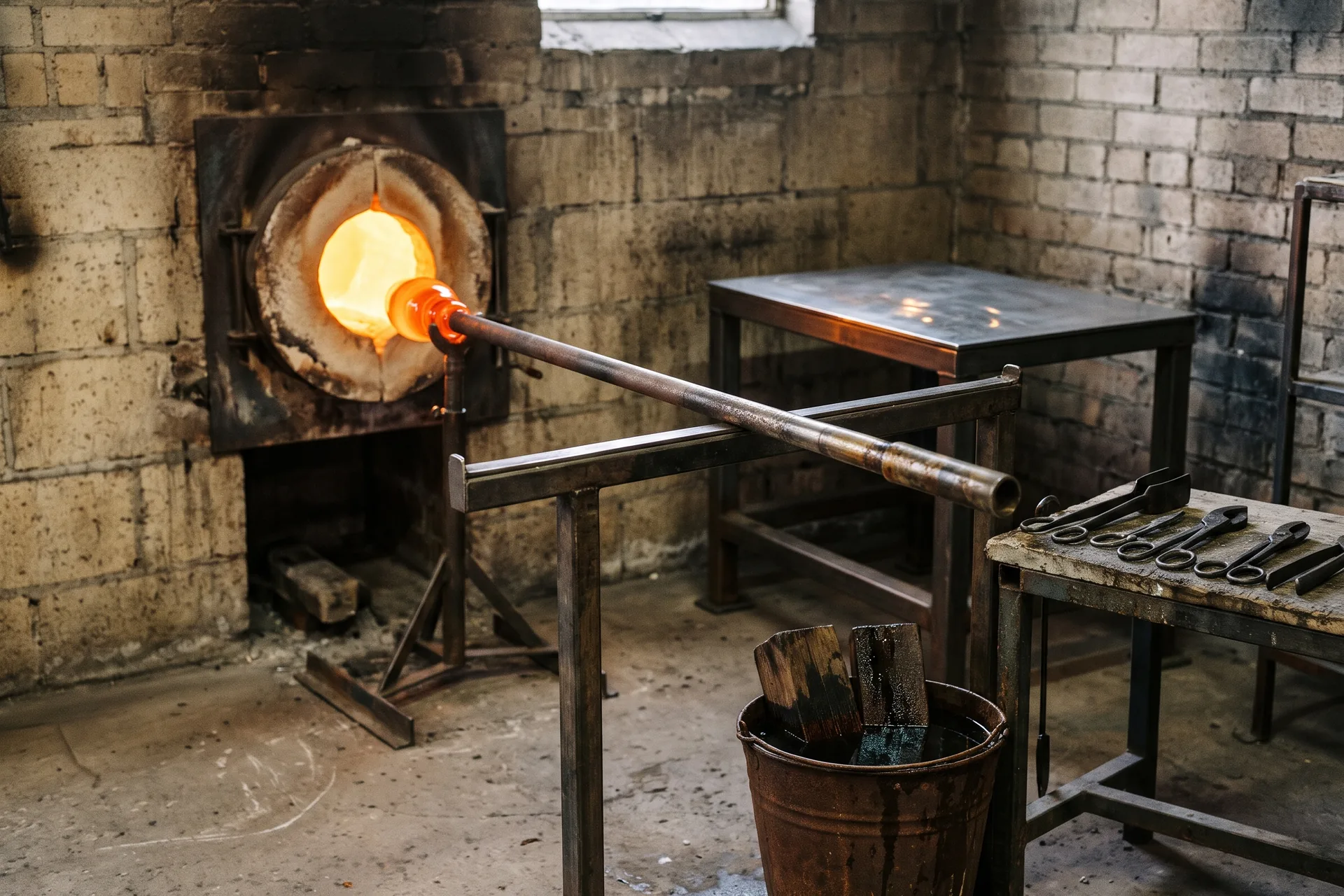
Hall VIMouth-blown glass4 min read
Blowpipe, furnace and the slow cooling of the lehr: how mouth-blown glass is made and how to recognise it.
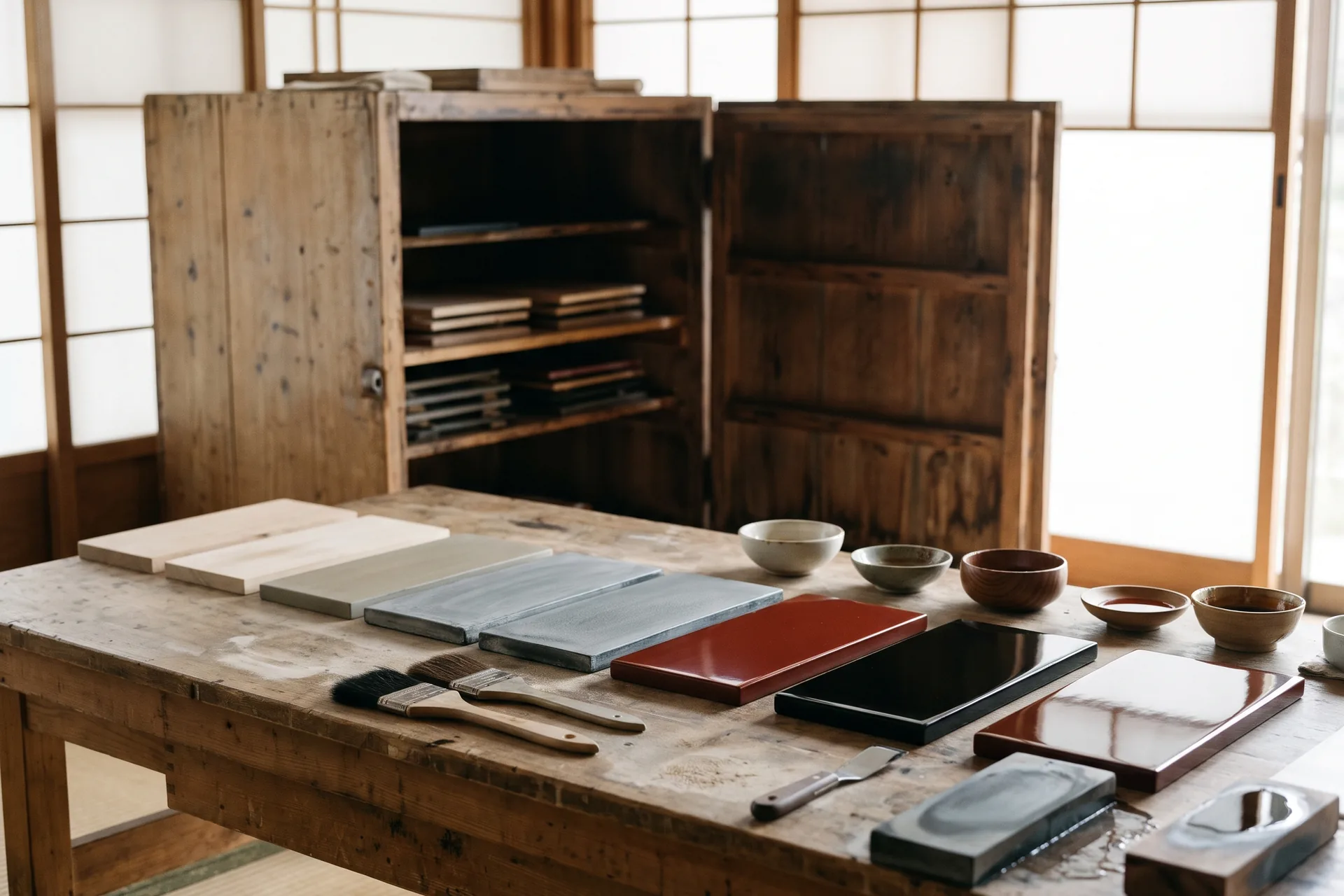
Hall VIUrushi5 min read
From urushi to Art Deco Paris: how lacquer is built coat by coat and why its depth cannot be hurried.
Press Ctrl K to search at any time