
Hall I, FurnitureUpholstery and frame5 min read
The Sofa, Considered
Frames, springs, cushions and covers: how to choose the piece a living room is built around.
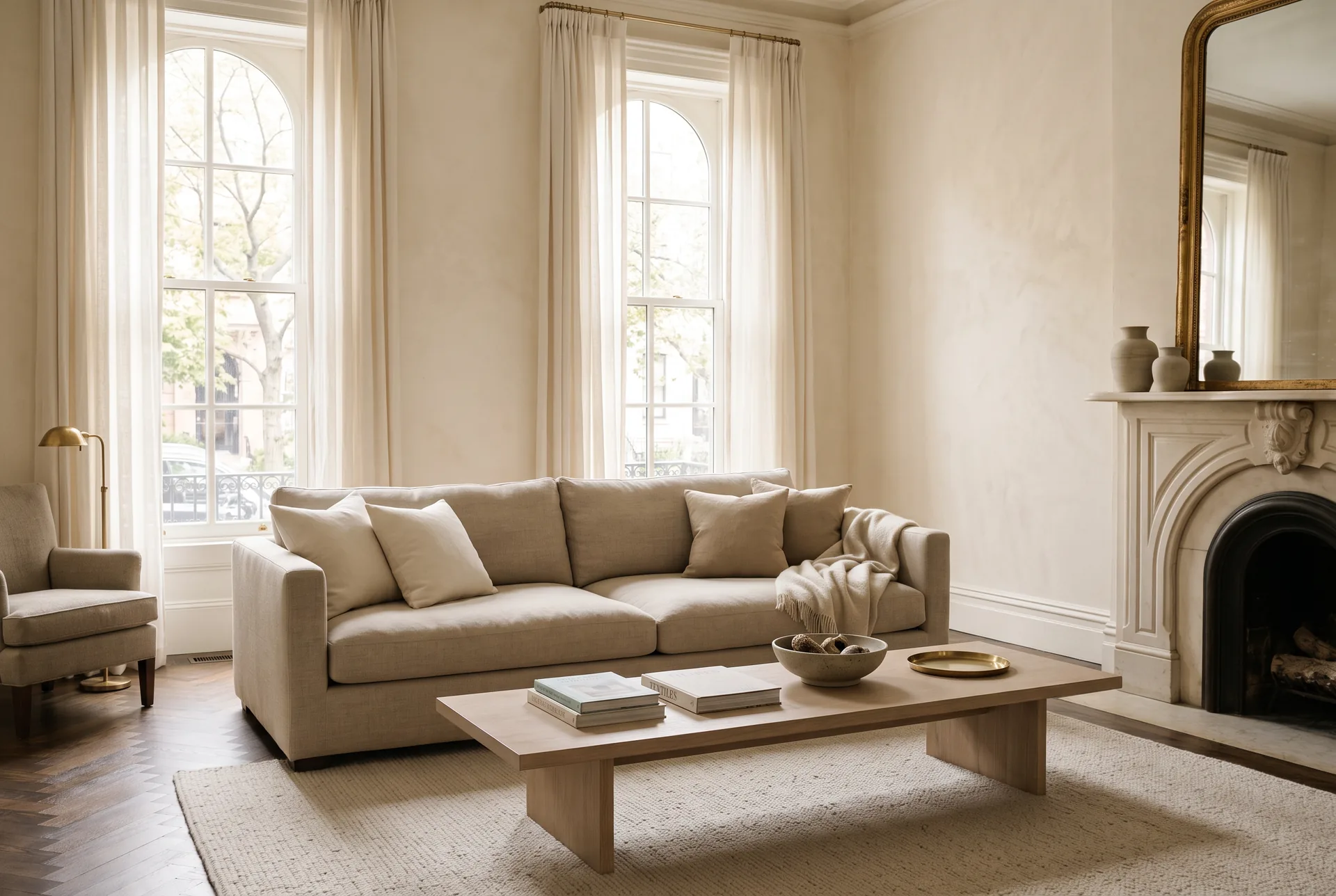
Late afternoon light crosses a pale room and comes to rest on a long, low sofa in oatmeal linen. Nothing about it insists, yet everything in the room seems arranged in its favour: the table, the lamp, the path from the door. This guide looks beneath the cover at frames, springs and cushions, then at the measurements and fabrics that decide whether a sofa will carry a room for years.
At a glance
- A good sofa frame is kiln-dried hardwood, joined with dowels, glue and corner blocks.
- Hand-tied coil springs, serpentine springs and elastic webbing each suit a different silhouette and way of sitting.
- A seat about 40 to 45 cm high and 50 to 60 cm deep suits upright sitting.
- Place the coffee table 40 to 45 cm from the seat and keep main walkways around 90 cm.
The frame you never see
Every sofa begins as a skeleton, and the skeleton decides how long everything laid over it will last. The traditional choice is kiln-dried hardwood such as beech, ash or oak. Drawing out the moisture before the timber is cut keeps it stable in a heated room, so the joints hold fast.
In a well-built frame the rails are joined with hardwood dowels and glue, and each corner is reinforced with a corner block, a small triangle of timber glued and screwed into the angle. To feel the result, lift one front corner a few centimetres off the floor: a good frame feels heavy, the other front leg rises almost at once, and nothing flexes in your hands.
Between frame and cushions sits the suspension, which gives a seat its resilience. The oldest method is hand-tied coil springs: the upholsterer ties each steel coil to its neighbours and to the frame with twine, often in eight directions, so that they move as one even surface. A seat made this way can be retied and restored for generations.
Serpentine or sinuous springs, lengths of zigzag steel wire running from front rail to back, give firm, consistent support in a shallower profile that suits clean lines. Elastic webbing, taut bands stretched across the frame, is lighter still; many slender mid-century designs rest on it. Each suits its own silhouette and way of sitting.
What holds a sofa together is never seen, yet always felt.
Cushions and their character
The cushion is where you meet the sofa, and its filling shapes both comfort and outline. Three families cover most of what you will find.
- High-resilience foam: holds its shape, keeps a crisp tailored line and needs little care.
- Foam wrapped in feather and down: a soft, yielding surface over a structured core.
- Feather and down blends: deep, relaxed and enveloping, with a gently crumpled look.
High-resilience foam suits an upright, architectural sofa whose outline should stay exact. A feather and down blend belongs to the deep, low sofa meant for long Sundays; its soft creases are part of the charm, and plumping the cushions each morning keeps them generous.
Foam wrapped in feather and down is the middle path: the first moment feels soft, then the core takes over and holds you. Whatever the filling, choose zipped covers so cushions can be turned and swapped between seats, letting wear spread evenly.
Measuring comfort
Comfort has numbers. Seat height, from the floor to the top of the seat cushion, usually falls around 40 to 45 cm. Lower seats feel relaxed and informal; higher ones are easier to rise from and suit conversation.
Seat depth matters even more. Measure the usable depth, from the front edge to the face of the back cushion, rather than the overall depth. About 50 to 60 cm suits upright sitting with your feet on the floor; deeper seats invite you to tuck your legs up, and taller people often prefer them.
Back and arm height shape how a sofa sits in the room as much as how it sits beneath you. A low back keeps sightlines open; a high back supports the head and gives a sense of enclosure. Low arms make a sofa read longer and invite you to stretch out; high arms feel sheltering.
The shape of the arm sets the tone. A track arm, straight and squared, draws a crisp line; a rolled arm curves outward and softens the silhouette. The deep-buttoned Chesterfield, with arms and back at one continuous height, became popular in nineteenth-century Britain and still brings the warmth of a library to any room.
Covers that live well
You touch the cover every day, so choose it with your hands as much as your eyes. Linen is cool and dry, takes colour beautifully and settles into relaxed creases. Wool is springy, warm and quick to recover. Velvet’s pile catches the light, so its colour shifts as you move. Bouclé, woven from looped yarn, softens hard architecture; leather warms to the body and gathers a patina over the years.
Then decide between fixed upholstery and loose covers. Fixed upholstery is fitted tightly to the frame for the sharpest, most tailored outline. Loose covers lift off for cleaning, which makes pale linen practical even with children at home, and a second set lets one sofa change with the seasons.
For durability, ask about the Martindale rub test. A fabric sample is rubbed against a standard abrasive cloth in a repeating figure-of-eight motion, and the cycles it withstands before showing wear are counted. Higher counts suit family rooms, pets and daily use.
The sofa in its room
A few proportions help a sofa settle into its room. A coffee table about two thirds the length of the sofa feels balanced, generous enough to serve everyone seated while leaving the ends free. Set it 40 to 45 cm from the front of the seat: close enough to reach a cup without leaning, with room left for knees.
Main walkways want around 90 cm, so people can pass behind the sofa with ease. A sofa need not stand against a wall; floated with a narrow console behind it, it can divide a large room into a quiet seating area and a passage. Before you order, measure every doorway, stair turn and lift the sofa will meet on its way in.
The Proportion Guide works through these distances for your own floor plan, in centimetres, from the gap in front of the sofa to the space around a dining table. Then mark the outline on the floor with low-tack tape and live with it for a day or two.
Choose slowly, then live with the sofa generously. An honestly built frame will accept new covers, new cushions and new rooms over the years, and each time it will do what it did on that first afternoon: gather the light, and the people, quietly around it.
Tool04 Proportion Guide Sofa, coffee table, dining table, clearances and walkways, worked out in centimetres. Open the toolQuestions and answers
How can I tell whether a sofa frame is well made?
Lift one front corner a few centimetres off the floor. A well-made frame feels heavy and rises as one piece, with the other front leg lifting almost at once. Ask whether the frame is kiln-dried hardwood joined with dowels, glue and corner blocks, the traditional marks of careful construction.
How deep should a sofa seat be?
Measure the usable depth, from the front edge of the seat to the face of the back cushion. Around 50 to 60 cm suits upright sitting with your feet on the floor. Deeper seats suit lounging and taller people, and a few scatter cushions make them comfortable for everyone else.
What does the Martindale rub test tell me about a fabric?
It measures abrasion resistance. A sample is rubbed against a standard abrasive cloth in a repeating motion until it shows wear, and the number of cycles is recorded. Higher counts indicate a more hard-wearing cover, which suits family rooms, pets and sofas in daily use.
Terms in this article
- Corner block
- A small triangular piece of timber glued and screwed into the inside corner of a sofa frame to keep the joint rigid.
- Hand-tied springs
- Steel coil springs tied by hand to one another and to the frame with twine, so that they move together as one supportive surface.
- Martindale rub test
- A laboratory test that measures the abrasion resistance of a fabric by counting the rubbing cycles it withstands before showing wear.
Filed underfurnituresofaupholsterycomfortproportion