
Hall I, Furniture1920s and 1930s5 min read
The Language of Art Deco Furniture
Macassar ebony, shagreen and lacquer: reading the forms and materials of the 1920s and 1930s.
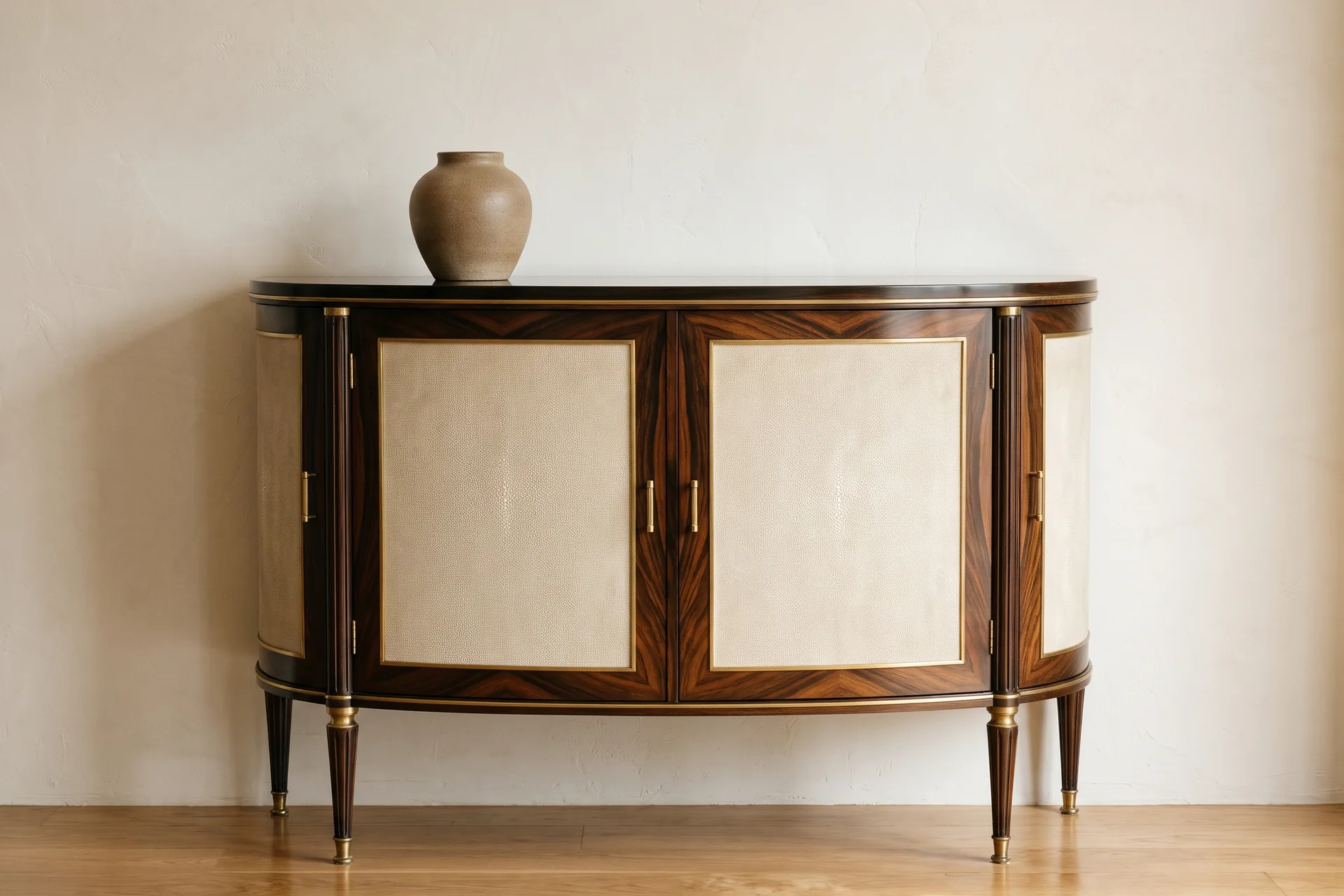
A cabinet stands against a pale wall, its doors veneered in macassar ebony whose stripes run like dark water, its slender legs ending in small shoes of gilt bronze. Nothing on it is loud, yet every line has been weighed. This is the language of Art Deco furniture, and once you can read it, you will recognise it in a single glance. Here are its materials, its forms and the signs of quality.
At a glance
- Art Deco is named after the 1925 Paris Exposition internationale des Arts décoratifs.
- Macassar ebony, amboyna burl, lacquer, shagreen and parchment are characteristic Art Deco materials.
- Tapered and fluted legs, sabots, stepped fronts and geometric marquetry define its forms.
- Precise veneer matching, finely chased mounts and tight construction are the marks of quality.
A style named after an exhibition
Art Deco takes its name from the Exposition internationale des Arts décoratifs et industriels modernes, held in Paris in 1925. The exhibition gathered the decorative arts of the moment: furniture, lacquer, glass, metalwork, textiles. The term Art Deco itself came into wide use later, but the furniture it describes flourished through the 1920s and 1930s.
At its summit stood French cabinetmaking of extraordinary refinement. Émile-Jacques Ruhlmann is regarded as a master of the period: his pieces combine rare veneers, delicate inlays and tapering legs with proportions so balanced that they seem to float. His work shows what the best of Art Deco shares, a classical sense of order expressed in new materials and a precise, modern line.
Around such workshops gathered lacquer artists, bronze casters, glassmakers and weavers, each contributing to the same idea of a complete interior. A Deco room was often conceived as a whole, from the panelling and the rug to the handle of a drawer, and its furniture still carries that sense of belonging to an ensemble.
Rare woods and precious skins
Art Deco furniture is above all a feast of surfaces. Its cabinetmakers chose materials for figure, depth and the way they hold light, and they placed them with a jeweller’s precision.
- Macassar ebony: a dense wood from Sulawesi, boldly striped in black and warm brown
- Amboyna burl: a tightly swirling, honey-coloured veneer full of small eyes
- Sycamore: pale, fine and even, often used to contrast with darker woods
- Lacquer: many thin layers, rubbed down and polished to a deep, still gloss
- Shagreen, called galuchat in French: ray skin with a surface of tiny nodules
- Parchment: a translucent, softly mottled skin laid over panels and tops
- Gilt bronze: mounts, escutcheons and the small shoes that cap the legs
- Chrome: the bright metal of the later, streamlined years
Lacquer deserves a word of its own. Built up in many layers and polished between coats, it can take weeks of patient work, and its depth comes from that slowness. Shagreen, sanded smooth and often dyed in soft greens or ivory, was laid on boxes, desks and small cabinets like a precious skin, its tiny pattern catching the light.
Lines, legs and fronts
The forms of Art Deco are as recognisable as its materials. Legs taper towards the floor, often fluted with fine parallel grooves, and frequently end in small metal shoes called sabots, which protect the wood and give a final accent. Cabinet fronts are stepped or gently curved, so that light slides across them and their edges read as fine lines.
Ornament is concentrated and geometric. Sunbursts, chevrons, stylised flowers and fan shapes appear in marquetry, in carving or in the inlay of a door, framed by large calm areas of veneer. The contrast between plain surface and a single precise motif is one of the great pleasures of the style.
In the 1930s the streamline influence softened these forms. Corners rounded, chrome joined or replaced bronze, and lacquer spread across larger surfaces, echoing the smooth shapes of ocean liners, aircraft and cars of the period. Furniture of these years feels faster and lighter, while keeping the earlier love of rich finishes.
Recognising quality
Look first at the veneer. In a fine piece the leaves are matched with great care, mirrored or arranged so that the figure flows across doors and drawers without a break. Look along the surface against the light: it should be even, without ripples, and the edges should be crisp.
Then look at the mounts and the construction. Good gilt bronze is finely cast and chased, its details sharp rather than blurred, and it fits the wood closely. Open the doors and drawers: they should move smoothly, the interiors should be as carefully finished as the outside, and the joints should be tight and even.
Finally, ask about condition and history. Original finishes, mounts and handles are precious, and a well-documented restoration is part of a long life. Veneer that has lifted or lacquer that has dulled can be beautifully conserved by a specialist, and a dealer who knows the piece will explain what has been done and why.
In Art Deco, proportion speaks first and the precious materials answer.
A Deco piece in a living room
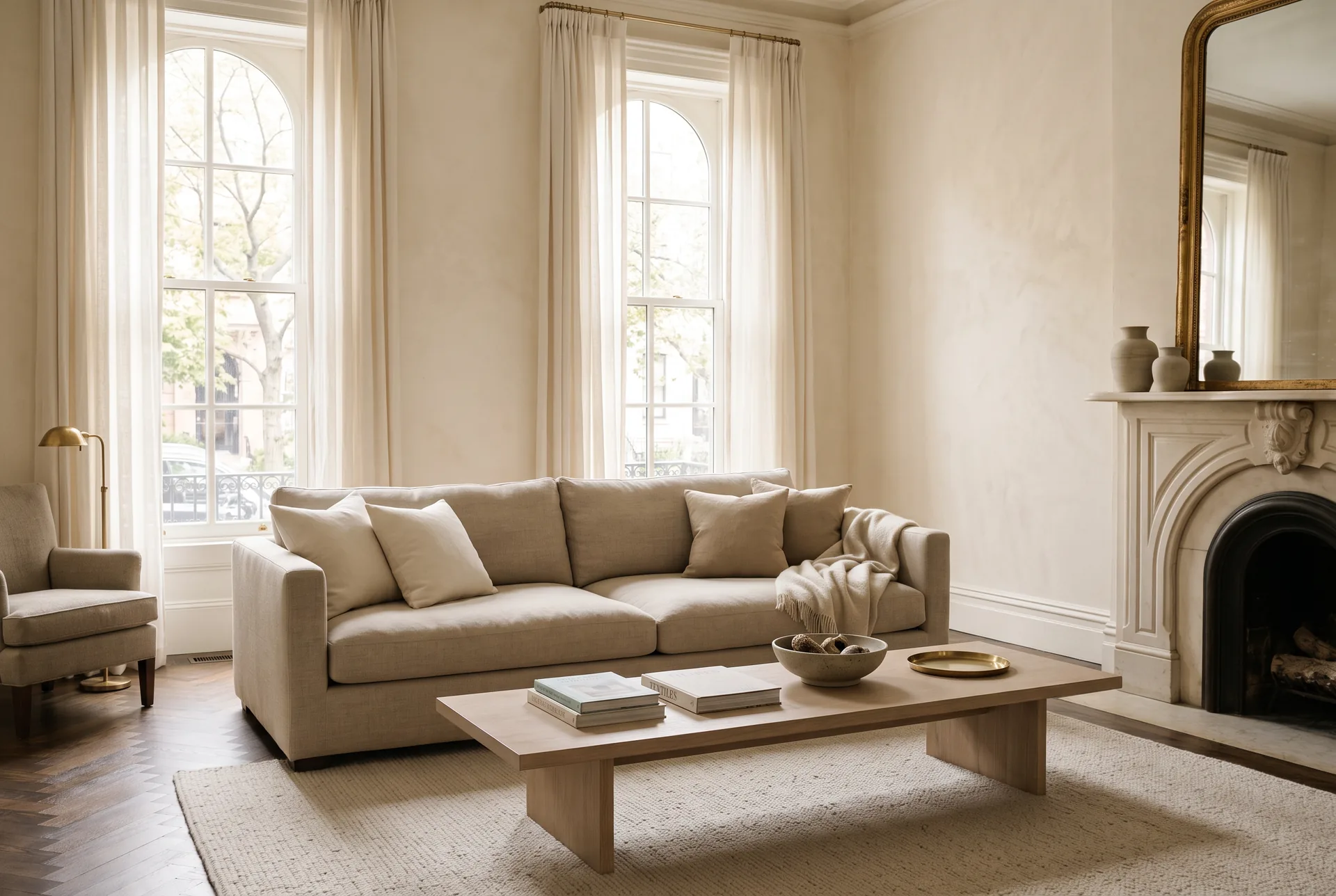
Art Deco rarely needs company of its own kind. One strong piece, a cabinet, a desk or a pair of armchairs, gains presence when the room around it stays calm: pale walls, a simple rug, linen at the windows. The contrast between a richly figured veneer and quiet surroundings lets its lines be read clearly.
Light it as you would a work of art. A lamp placed to one side brings out the depth of lacquer and the stripe of macassar ebony; overhead light flattens them. If you are unsure whether the style suits you, the Style Finder asks eight questions in images and points you towards the interiors and articles that match your taste.
Live with it for a while and the details begin to emerge: the way a leg narrows, the grain that runs from one door into the next, the soft glow of a bronze shoe. A century after the Paris exhibition, this furniture still speaks clearly to anyone willing to look closely.
Tool05 Style Finder Eight visual questions that lead to the interior style you already live in. Open the toolQuestions and answers
Where does the name Art Deco come from?
The name comes from the Exposition internationale des Arts décoratifs et industriels modernes, held in Paris in 1925. The term itself came into wide use later, but it now describes the decorative style that flourished through the 1920s and 1930s, in furniture, glass, lacquer, metalwork and architecture.
What is shagreen?
Shagreen, called galuchat in French, is the skin of the ray, with a surface of tiny rounded nodules. It is sanded smooth, polished and often dyed in soft greens or ivory. Art Deco makers laid it on boxes, desks and small cabinets, where its fine texture catches the light.
How can I place an Art Deco piece in a contemporary room?
Let one strong piece lead and keep its surroundings calm, with pale walls, a simple rug and few objects nearby. Light it from the side with a lamp so that lacquer and veneer show their depth. The contrast between rich materials and quiet space lets its lines read clearly.
Terms in this article
- Sabot
- A small metal shoe, often of gilt bronze, that caps the foot of a furniture leg to protect the wood and add an accent.
- Fluting
- Fine parallel grooves cut along the length of a leg or column, adding rhythm and catching the light.
- Amboyna burl
- A richly figured, honey-coloured veneer cut from the burl of a tropical tree and much loved in Art Deco cabinetmaking.
Filed underfurnitureart decoveneerlacquercollecting