
Hall I, FurnitureWalnut and stone5 min read
The Dining Table and the Art of Gathering
Wood or stone, round or long: the measurements and materials behind long, unhurried dinners.
A long table at the end of a summer evening: plates pushed back, candles burnt low, someone refilling glasses while the conversation turns once more. The table itself is hardly noticed, which is the finest thing a dining table can achieve. Behind that ease lie a few measurements and honest materials. This guide sets out the space each guest needs, the shapes that suit a room and the woods and stones that age with grace.
At a glance
- Allow about 60 cm of table edge per person, or 70 cm for generous settings.
- A table depth of 90 to 100 cm leaves room for serving dishes down the centre.
- Round tables of about 120 to 135 cm seat six, and about 150 cm seats eight.
- Hang a pendant 75 to 90 cm above the top and leave 90 cm to the walls.
Room for every guest
Generosity at the table is measured along its edge. Allow about 60 cm of table edge for each person: enough for a plate, cutlery and a glass without elbows meeting. For dinners that linger over several courses, or for chairs with arms, 70 cm feels more relaxed, and the table begins to seem hospitable rather than merely adequate.
Depth matters as much as length. A top of around 90 to 100 cm leaves a band down the middle for serving dishes, a jug of water and a low arrangement of flowers, while guests facing one another can still talk without raising their voices. Narrower refectory tables have their own intimacy and suit dinners served plated from the kitchen.
Height is more settled. Most dining tables stand around 75 cm high and most dining chairs offer a seat height of around 45 cm, which leaves roughly 30 cm between seat and top for knees and thighs. Check this gap when you pair an older table with newer chairs, and allow for the apron, the frame beneath the top, which reduces it.
Round, oval or long
A round table gathers people. Everyone can see everyone, nobody sits at the head and conversation crosses the table instead of travelling along it. A few rules of thumb help with the diameter.
- About 90 to 110 cm seats four in comfort
- About 120 to 135 cm seats six
- About 150 cm seats eight, with room in the centre for shared dishes
Beyond eight, a round top grows so wide that the far side drifts out of reach, and an oval or a long rectangle becomes the better choice. An oval keeps the softness of the circle while seating more; its curved ends ease movement in a narrow room and make the table feel less like a barrier.
Long rectangular tables suit grand rooms and large families. Extending tables, with leaves stored inside the frame or alongside it, answer the occasional large dinner while keeping a more intimate size for everyday meals. Ask to see the mechanism worked, and check that the extra leaves match the main top in figure and colour.
Wood, stone and lacquer
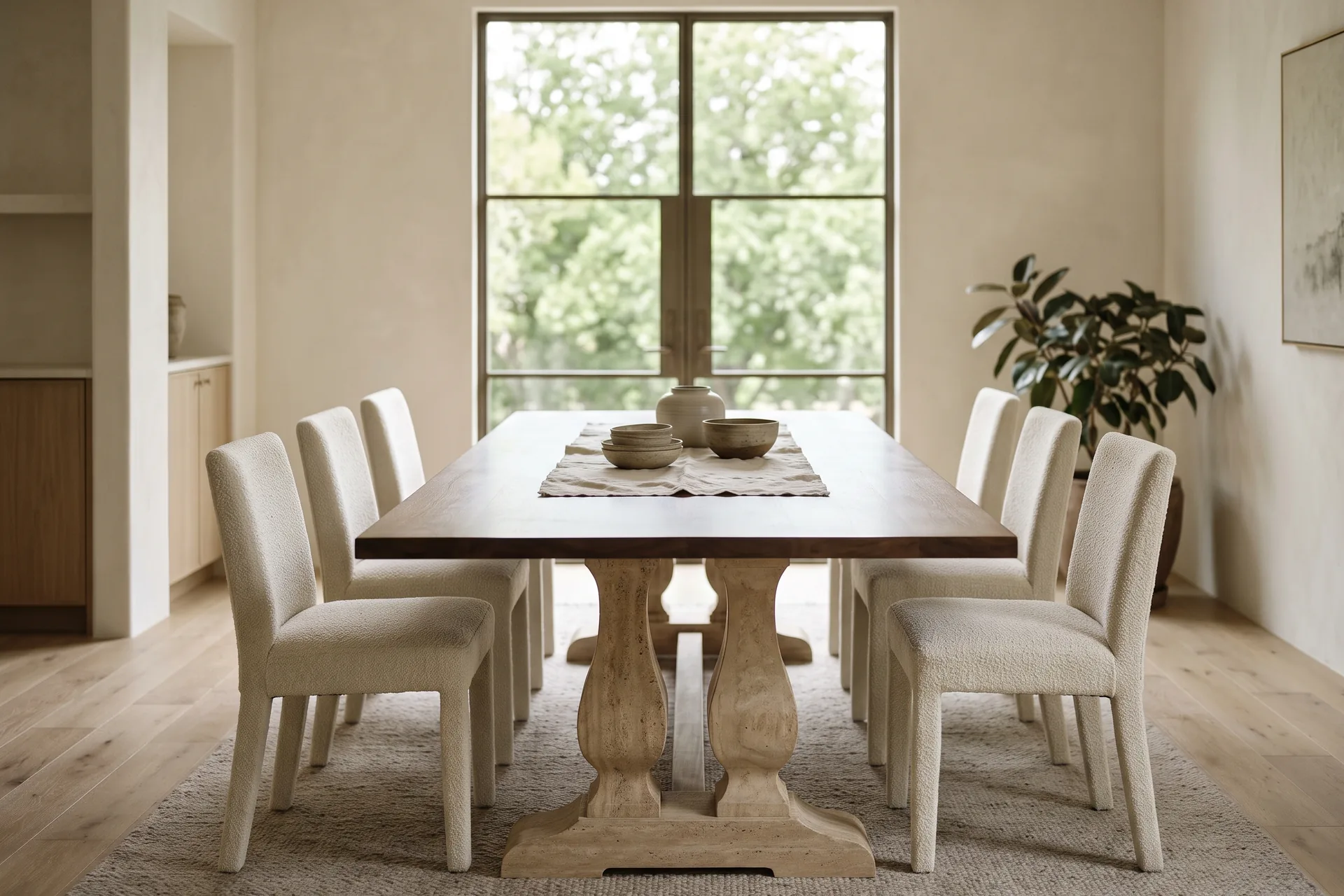
Solid oak is the steady companion of a dining room: strong, open-grained, easy to oil and quick to forgive a scratch. Walnut brings warmth and a lively figure from honey to chocolate brown; ash, pale and springy, gives a light northern clarity. Solid wood moves gently with the seasons, so a good top is made to expand and contract without strain.
Veneered tops lay thin leaves of fine timber on a stable core, which allows wide surfaces, matched figure and rare woods that would be impractical in solid planks. A well-made veneered table is a work of cabinetmaking in its own right, and the core keeps it flat in centrally heated rooms.
Stone gives a table weight and coolness. Marble is loved for its veining and depth; it is relatively soft and etches on contact with acids such as wine, lemon or vinegar, so a honed finish, which shows such marks far less than a polish, and a good impregnating sealer make it easy to live with. Travertine offers warm pores and banding, limestone a calm, even surface, and a lacquered top reflects candlelight like still water.
Legs, trestles and pedestals
The base decides who sits where. Four legs at the corners give a classic, stable table, but they claim the corners and set the number of places along each side. Trestles, two end supports joined by a stretcher, recall the refectory and leave the long sides free; check where the stretcher runs, so that feet can rest comfortably.
A pedestal base, a single central column or foot, frees the legroom entirely, so chairs can stand anywhere around the top. It is the natural partner of round and oval tables, and in stone or turned wood it becomes a sculpture beneath the table. Larger oval and rectangular tops often rest on two pedestals.
The Proportion Guide works through table sizes, places and clearances for your own room in centimetres, so you can test a round table against an oval one before anything is ordered. Allow at least about 90 cm between the table edge and a wall or sideboard, enough to pull a chair back and for someone to pass behind it.
The best tables are measured in centimetres and remembered in evenings.
Light and the chairs
A pendant or chandelier ties the table to the room. Hang its lowest point around 75 to 90 cm above the top: low enough to gather the table into a pool of light, high enough to leave faces and sightlines clear. Over a long table, two or three smaller pendants or one long fitting follow its length, and on a dimmer the light can sink as the evening deepens.
Chairs complete the table. Armless chairs tuck neatly beneath the top and allow an extra place to be found; chairs with arms invite guests to lean back and linger, but they need more width and their arms must clear the apron. Upholstered seats in leather, wool or velvet make long dinners kinder, and carvers at the ends with armless chairs along the sides follow a long tradition.
Then let the table be used. Oak darkens, walnut mellows and marble gathers the faint traces of good dinners, each becoming part of its story. Chosen with care, a dining table is the one piece of furniture that keeps a household, and its friends, returning to the same place.
Tool04 Proportion Guide Sofa, coffee table, dining table, clearances and walkways, worked out in centimetres. Open the toolQuestions and answers
How much space does each person need at a dining table?
Allow about 60 cm of table edge for each person, which holds a plate, cutlery and glasses comfortably. For long dinners, chairs with arms or simply a more generous feeling, plan around 70 cm. Remember that legs at the corners can reduce the usable places along each side.
What size round table seats six people?
As a rule of thumb, a round table of about 120 to 135 cm in diameter seats six. Four people sit well at about 90 to 110 cm and eight at about 150 cm. A pedestal base frees the legroom, so chairs can be placed anywhere around the top.
Is marble a good choice for a dining table?
Marble is a beautiful and lasting choice when you know its nature. It is relatively soft and etches on contact with acids such as wine, lemon or vinegar. A honed finish, a good impregnating sealer and wiping spills promptly keep it calm and lovely for many years.
Terms in this article
- Apron
- The frame of rails set just beneath a tabletop that joins the legs and stiffens the whole structure.
- Pedestal base
- A single central column or foot that carries a tabletop and leaves the legroom around it free.
- Trestle table
- A table whose top rests on two end supports, usually joined by a stretcher, in the manner of the refectory.
Filed underfurniturediningtablesproportionmaterials