
Hall I, FurnitureJoinery5 min read
Made to Measure: Commissioning Cabinetry
From first drawing to final fitting, how a joinery commission unfolds and what to ask along the way.
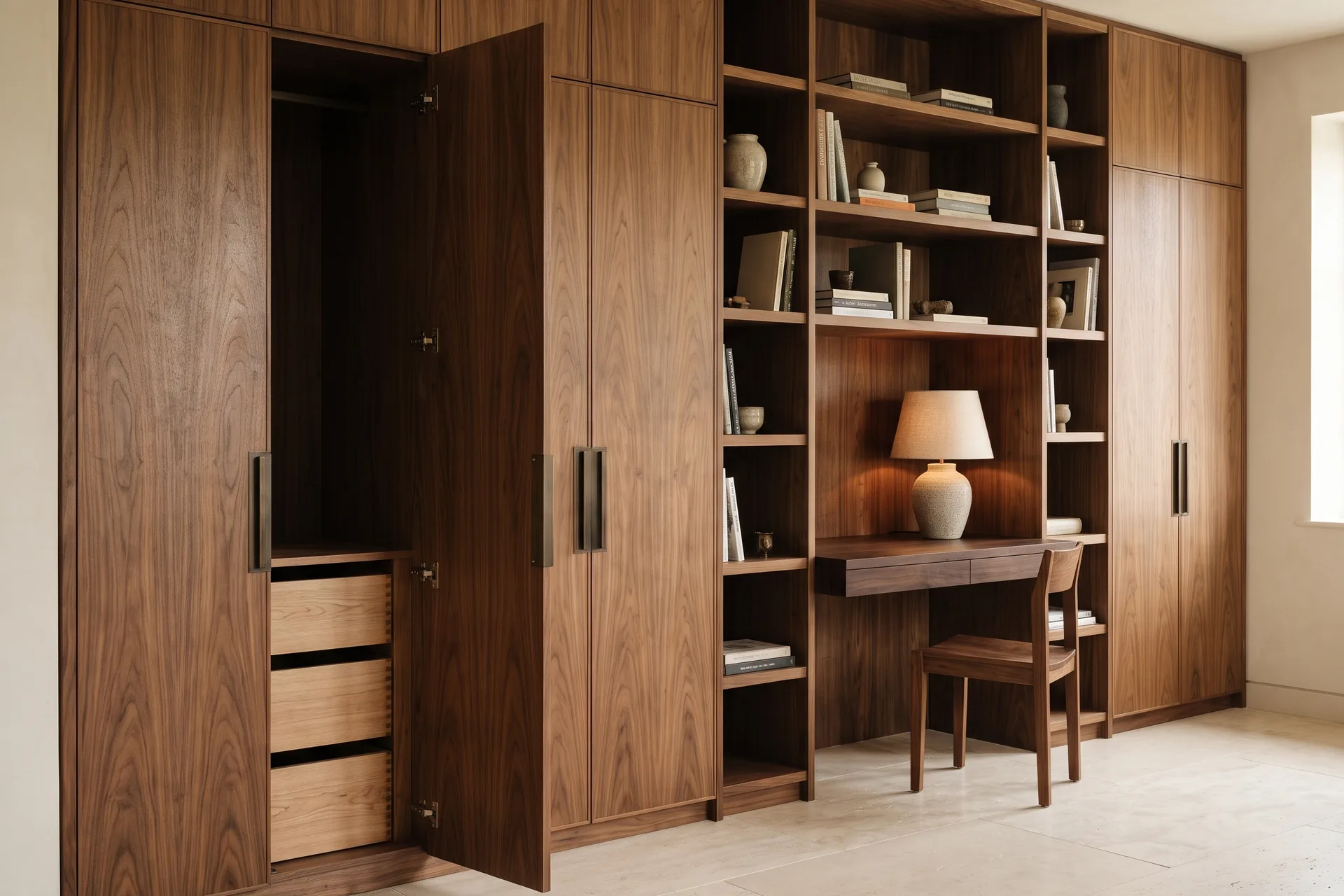
A wall of walnut opens to reveal a library, a bar and a desk that folds away by evening. Every shelf is set to the height of the books it holds, and every door closes with the same soft sound. Cabinetry like this is not bought but commissioned, and the commission is a conversation between you and a workshop. This guide follows it from the first drawing to the final fitting, with the questions worth asking at each stage.
At a glance
- A commission moves from brief and survey to drawings, samples, making, finishing and installation.
- Dovetails join drawer corners, while mortise and tenon joints hold the frames of doors.
- Panels float in their frames because solid wood moves with changes in humidity.
- Ask for samples of the actual timber, a workshop visit and a clear written schedule.
The brief and the survey
Begin with the life the cabinetry will hold rather than with its appearance. What needs a home: books, records, glassware, a television that should disappear, linen, shoes, the papers of a study? Note the sizes of the things you own, how often you reach for them and who will use each part. Photographs of rooms and details you love help a maker understand your taste far better than adjectives.
Then comes the survey. The maker measures the room precisely, because walls are rarely perfectly plumb, floors rarely level and ceilings vary by more than the eye admits. Sockets, switches, pipes, radiators and ventilation are all recorded, so that the cabinetry can embrace them. Good fitted joinery is scribed to the room, its edges shaped to follow every small irregularity.
From brief and survey the drawings grow: plans, elevations and sections, then details at full size for mouldings, handles and the meeting of doors. Read them slowly, ideally in the room itself, and ask for anything unclear to be drawn again. A line on paper is the cheapest place to change your mind.
Samples, mock-ups and decisions
Ask for samples of the actual timber that will be used, cut from the boards or the veneer set reserved for your commission and finished exactly as specified. A small piece of walnut in oil looks quite different from the same walnut lacquered, and both change again in the light of your own room. Look at samples in the morning and in the evening before you approve them.
For complex elements a mock-up is invaluable. A full-size front in plywood or card, propped against the wall, shows proportions that drawings cannot. A single prototype drawer lets you feel the runners and the weight of the handle. These small steps take time, and they are the surest way to a result that feels inevitable.
Record every decision. Signed drawings, labelled samples and written notes on finishes and hardware form the reference for everyone involved, from the cabinetmaker at the bench to the fitter on site.
Joints that last
The strength of cabinetry lies in its joints. Dovetails, with their interlocking, fan-shaped tails and pins, join the corners of drawers and resist being pulled apart each time a drawer is opened; cut by hand, with slender pins, they are a traditional sign of care. Mortise and tenon joints, a tongue fitted and glued into a matching cavity, hold the frames of doors and face frames. Dowels, round pins of hardwood, join carcass parts with quiet precision.
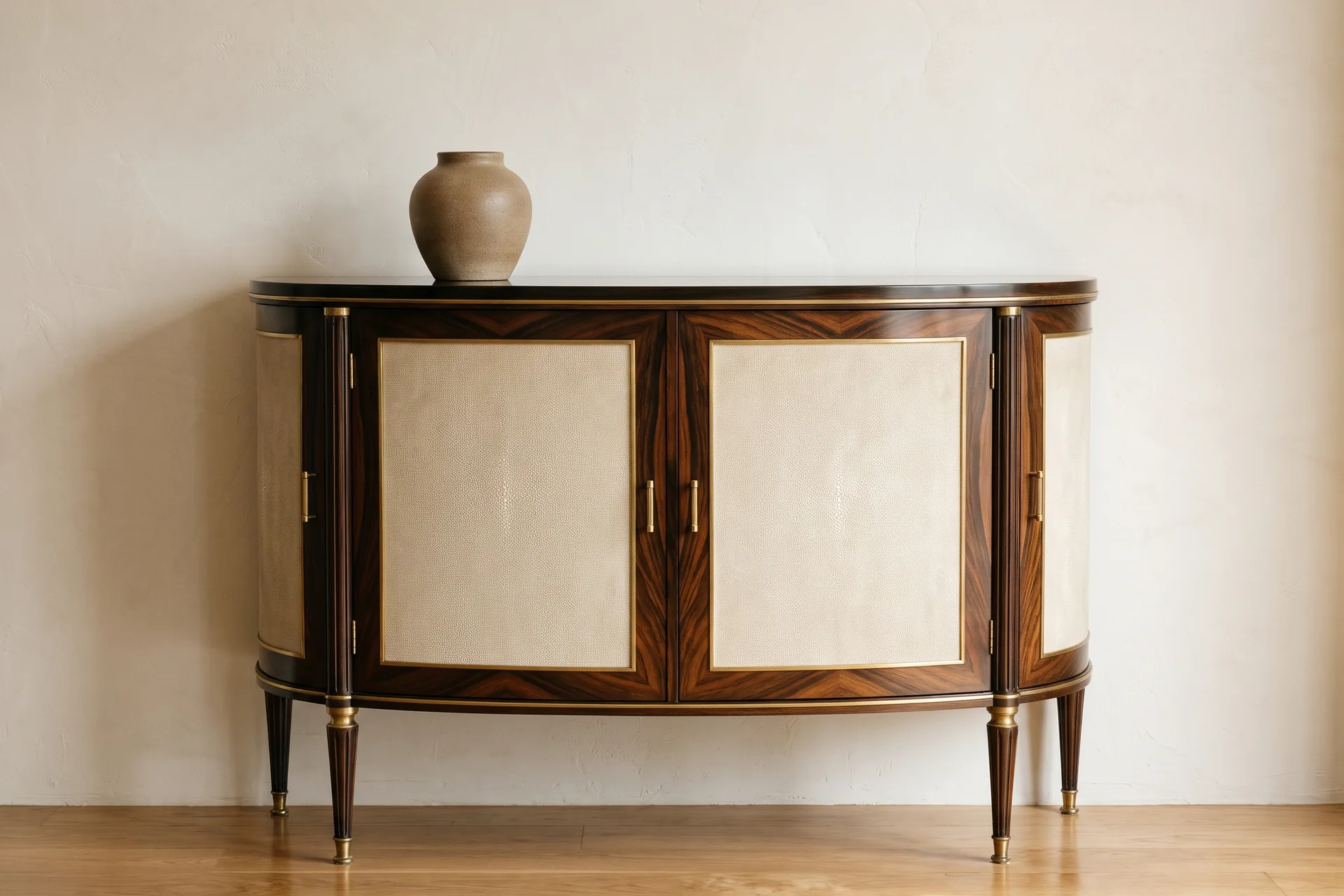
Solid wood moves. It takes up and releases moisture with the seasons and expands and contracts across its grain, so a good maker never traps it. In frame and panel construction the panel floats in a groove within its frame, free to move while the frame stays true. Veneer laid on a stable core allows wide, flat surfaces and book-matched figure, with leaves opened like the pages of a book so that the grain mirrors across a pair of doors.
- Oak: strong and open-grained, beautiful oiled, fumed or limed
- Walnut: warm brown with a lively figure, superb as veneer
- Ash: pale, straight-grained and resilient
- Cherry: fine and smooth, deepening to a warm red in the light
- Maple: pale, dense and even, sometimes with a rippling figure
Finish and hardware
The finish decides how the wood feels and ages. Oil soaks into the fibres and leaves a natural, matt surface that is easily renewed; wax adds a soft sheen. French polish, shellac dissolved in alcohol and applied in many thin coats with a cloth pad, builds a deep, glassy shine that shows the figure as nothing else does. Lacquer, from matt to high gloss, gives a durable surface that suits kitchens and dressing rooms.
Hardware is where the hand meets the piece every day. Concealed hinges keep fronts clean, while traditional butt hinges set into the edge suit a period door. Handles may be cast bronze, turned wood, leather or a simple recess for the fingers. Soft-close runners let even the heaviest drawer glide shut; ask to try each item, because its weight and movement matter as much as its look.
A drawer that closes softly is the signature of the whole workshop.
In the workshop and on site
Visit the workshop if you can. You will see the benches, the timber store and pieces in progress, and you will meet the people who will make yours. A maker proud of the craft is glad to show how a drawer is fitted or a veneer is laid, and such a visit builds the trust a commission depends on.
Much of the work happens before anything reaches your home. Parts are made, finished and often assembled in the workshop to be sure that everything fits, then taken apart again for delivery. On site, the fitters scribe the cabinetry to walls and ceiling, set it level and adjust each door until the gaps around it are even and fine.
When the fitters have gone, open every door and drawer once more and listen. The quiet click of a well-hung door, the smooth run of a drawer, the grain that continues from one panel into the next: these are the signs of a commission done well, and of furniture made to stay exactly where it belongs.
Questions and answers
Why do panels float in a frame?
Solid wood takes up and releases moisture with the seasons and expands and contracts across its grain. In frame and panel construction the panel sits in a groove within the frame without being glued, so it can move freely while the frame stays true and the door keeps its shape.
Is veneered cabinetry as good as solid wood?
Fine veneer on a stable core is a respected cabinetmaking tradition with its own strengths. It allows wide, flat surfaces that stay true, book-matched figure across pairs of doors and the use of rare, beautifully figured timbers. Solid wood is ideal for frames, edges, legs and drawer sides.
What should I ask a cabinetmaker before commissioning?
Ask to see finished work and to visit the workshop, request samples of the actual timber in the chosen finish, and agree a written schedule that names each stage. Ask which joints will be used, how the hardware works and how the cabinetry will be fitted on site.
Terms in this article
- Scribing
- Shaping the edge of fitted joinery so that it follows the small irregularities of a wall, floor or ceiling.
- Frame and panel
- A construction in which a panel sits loosely in a groove within a rigid frame, so that the solid wood can move.
- Carcass
- The basic box of a cabinet, formed by its sides, top, bottom and back, to which doors and drawers are fitted.
Filed underfurniturejoinerycabinetrywoodcommission