
Hall VI, Ateliers and CraftStoneware and glaze5 min read
The Language of Studio Ceramics
Stoneware, porcelain, celadon and raku: reading clay and glaze, and displaying ceramics with grace.
Pick up a bowl and feel its weight settle in your palm. The foot is unglazed and slightly rough, the wall rises in faint rings left by the potter’s fingers, and the glaze pools green at the bottom like water in a stone basin. Every studio pot can be read this way, slowly, by eye and hand. Here is how to understand clay and glaze, and how to display ceramics with grace.
At a glance
- Earthenware is porous unless glazed, stoneware dense and strong, porcelain fine, white and translucent.
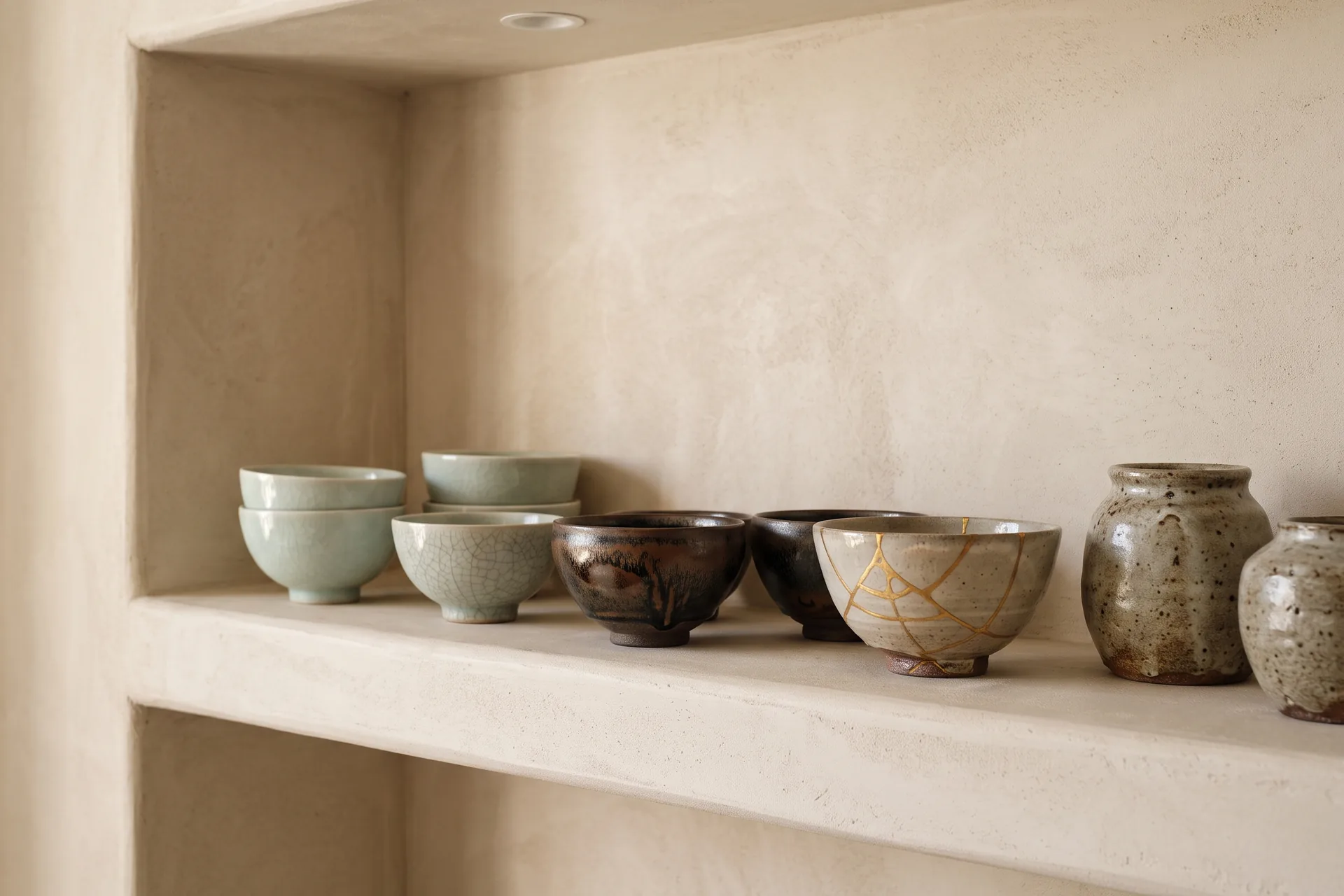
- Celadon, tenmoku, ash and crackle glazes each give clay a distinctive skin of glass.
- Raku and kintsugi come from Japan, the latter mending breaks with lacquer and metal powder.
- Display ceramics in odd-numbered groups of varied heights, on well-lit shelves, and use them daily.
Three bodies of clay
Potters speak of the clay body, the particular mixture of clays and minerals from which a piece is made, and three families cover most of what you will meet. Earthenware is fired at comparatively low temperatures. It remains porous unless it is glazed, and its colours run from warm red and terracotta to buff, which is why it has served for tiles, garden pots and painted tableware for thousands of years.
Stoneware is fired at high temperatures until the clay becomes dense, strong and practically impervious to water, even without a glaze. Its tones are earthy, from oatmeal to grey and deep brown, often flecked with iron, and its sturdy, honest character has made it the favourite body of many studio potters.
Porcelain is the finest of the three: white, hard and smooth, fired at very high temperatures until it vitrifies. Where it is thin it lets light through, so a porcelain bowl held up to a window glows softly. It is also the most demanding to work, since it is less forgiving on the wheel and in the kiln.
The skin of a glaze
A glaze is a thin layer of glass fused onto the clay in the kiln. It makes a pot watertight and easy to clean, and it gives the surface its colour, sheen and depth. Glazes are mixed from minerals, and small changes in the recipe, the thickness or the atmosphere of the kiln can transform the result, which is why potters test their glazes with such care.
Among the many glazes, a few families are especially worth knowing:
- Celadon: pale green to blue-grey, from the Chinese tradition, coloured by a little iron
- Tenmoku: a dark, lustrous iron glaze, black to rich brown, often breaking to rust at the rim
- Ash glazes: made with wood ash, flowing and pooling in soft greens and ambers
- Crackle glazes: covered in a fine network of cracks, sometimes darkened to stand out
Tenmoku takes its Japanese name from the Tianmu mountains in China, where Japanese monks encountered the dark tea bowls they later brought home. Ash glazes recall the oldest kilns, where wood ash settled on the pots during firing and melted into a glaze of its own accord.
Raku and kintsugi
Raku is a Japanese low-fire technique closely associated with the tea ceremony. Tea bowls, traditionally shaped by hand rather than thrown on the wheel, are fired, taken from the kiln while still glowing and cooled quickly, which gives lively surfaces of crackles, smoky blacks and subtly varied glazes. Each bowl is unique, and its slight irregularity is part of its beauty.
Because raku remains relatively porous, it asks for gentle use: tea bowls are rinsed and dried with care, and purely decorative pieces are best kept away from water.
Kintsugi, literally golden joinery, is the Japanese art of repairing broken ceramics with lacquer dusted with powdered gold or other metals. Instead of hiding the break, it traces it in a fine, shining line, so the repair becomes part of the object’s history and, many feel, of its beauty. It expresses a way of seeing that values a thing all the more for having been used and loved.
The studio pottery movement
Studio ceramics are made by individual potters or small workshops, by hand, on the wheel and in kilns they often build and fire themselves. The movement took shape in the early twentieth century, when potters in Europe, Japan and beyond sought a direct relationship between maker, material and fire.
In 1920 the English potter Bernard Leach and the Japanese potter Shoji Hamada founded a pottery in St Ives, Cornwall, drawing on East Asian and English traditions alike. Their work and writing encouraged generations of potters to value honest form, natural glazes and pots made for daily use.
To read a studio pot, look at the foot, often left unglazed so you can see the clay itself, at the throwing rings on the inside, at how the glaze has moved and pooled, and for the small stamp or mark with which many potters sign their work.
A pot is finished in the kiln, but completed only in the hand that uses it.
Living with ceramics
Ceramics are happiest when they are seen and used. Display them on open shelves with good light, ideally lit from the front or the side so glazes shine and textures cast small shadows, or on a deep windowsill where daylight moves over them through the day.
Arrange them as a composition, with related glazes and enough space for each piece to breathe. And use them: a stoneware bowl for breakfast, a porcelain cup for tea, a vase for branches from the garden. Pots made for daily use grow more beautiful with handling.
Care is simple. Wash fine glazes, gilded or lustred pieces and anything delicate by hand, avoid sudden changes of temperature, and place felt beneath unglazed feet, which can scratch a polished table. If a treasured piece breaks, keep every fragment: a restorer, or a kintsugi artist, can give it a second life.
Over time a collection becomes a portrait of its owner: the bowls you reach for, the vase that always holds something, the small cup you never lend. Clay and glaze carry the hand of the person who made them, and slowly, with use, they come to carry yours too.
Questions and answers
What is the difference between stoneware and porcelain?
Both are fired at high temperatures. Stoneware becomes dense, strong and practically watertight, with earthy colours often flecked with iron. Porcelain is finer, white and smooth, fired until it vitrifies, and where it is thin it lets light through. Many studio potters work in both, choosing the body for each form.
What is kintsugi?
Kintsugi is the Japanese art of repairing broken ceramics with lacquer dusted with powdered gold or other metals. Rather than hiding the break, it traces it in a fine, shining line, so the repair becomes a visible and honoured part of the object’s history.
How should studio ceramics be cared for?
Wash delicate glazes, gilded or lustred pieces and porous wares such as raku by hand, and avoid sudden changes of temperature. Place felt beneath unglazed feet to protect polished furniture. If a treasured piece breaks, keep all the fragments, since a restorer or kintsugi artist can often mend it.
Terms in this article
- Earthenware
- Pottery fired at comparatively low temperatures, which remains porous unless it is covered with a glaze.
- Tenmoku
- A dark, lustrous iron glaze, named after the Tianmu mountains in China and prized for tea bowls.
- Foot
- The ring or base on which a pot stands, often left unglazed so the clay body can be seen.
Filed underateliersceramicsstonewareporcelainglaze