
Hall VII, Fairs and Design WeeksParis4 min read
Paris, Salon of the Decorative Arts
Maison et Objet, Paris Design Week and the galleries of the Left Bank: the city where decoration became an art.
Late afternoon on the Left Bank. In a gallery window on a narrow street, a low table of patinated bronze stands beside a lamp with a parchment shade, and inside, the gallerist is turning on the lights one by one. A few streets away the Seine has turned to silver. Paris has been teaching the world to decorate for centuries. Here is how its fair, its design week and its galleries fit together.
At a glance
- Maison et Objet is a trade fair for decoration, furniture and interiors at Paris Nord Villepinte.
- During Paris Design Week, showrooms, galleries and studios across the city open their doors.
- The galleries around Saint-Germain-des-Prés specialise in twentieth-century and contemporary design.
- The Société des artistes décorateurs and the 1925 exhibition shaped Paris as a capital of decoration.
Where decoration became an art
Few cities have taken the decorative arts as seriously as Paris. For centuries its cabinetmakers, bronze casters, weavers, gilders and upholsterers supplied the courts and great houses of Europe, and the vocabulary of French furniture, from the commode to the bergère, is still spoken by designers everywhere.
In 1901 designers and craftspeople founded the Société des artistes décorateurs, a society devoted to raising the decorative arts to the standing of the fine arts and to presenting new work to the public. Its exhibitions became a meeting point for the modern movement in French decoration.
In 1925 Paris hosted the great Exposition internationale des Arts décoratifs et industriels modernes, the exhibition that later gave Art Deco its name. Pavilions of lacquer, glass, ironwork and rare woods presented a new and modern luxury, and the spirit of that exhibition still glows in the interiors, shopfronts and museums of the city.
Maison et Objet
Maison et Objet is the great trade fair for decoration, furniture and interiors, held at the Paris Nord Villepinte exhibition centre north of the city. It gathers manufacturers, studios and craftspeople presenting everything a room can hold: furniture and lighting, textiles and rugs, tableware, scents for the home and the small objects that complete a space.
Like most trade fairs, it is first of all a meeting place for professionals: interior designers, architects, hoteliers and retailers who come to discover new collections, to compare and to order. Its halls are organised by theme, so a clear list of what a project still needs helps you decide where to spend your time.
Arrive early, wear comfortable shoes and allow time for the journey from the centre. A fair of this kind is best taken in depth, a few halls at a time, rather than in one long and tiring sweep.
Paris Design Week
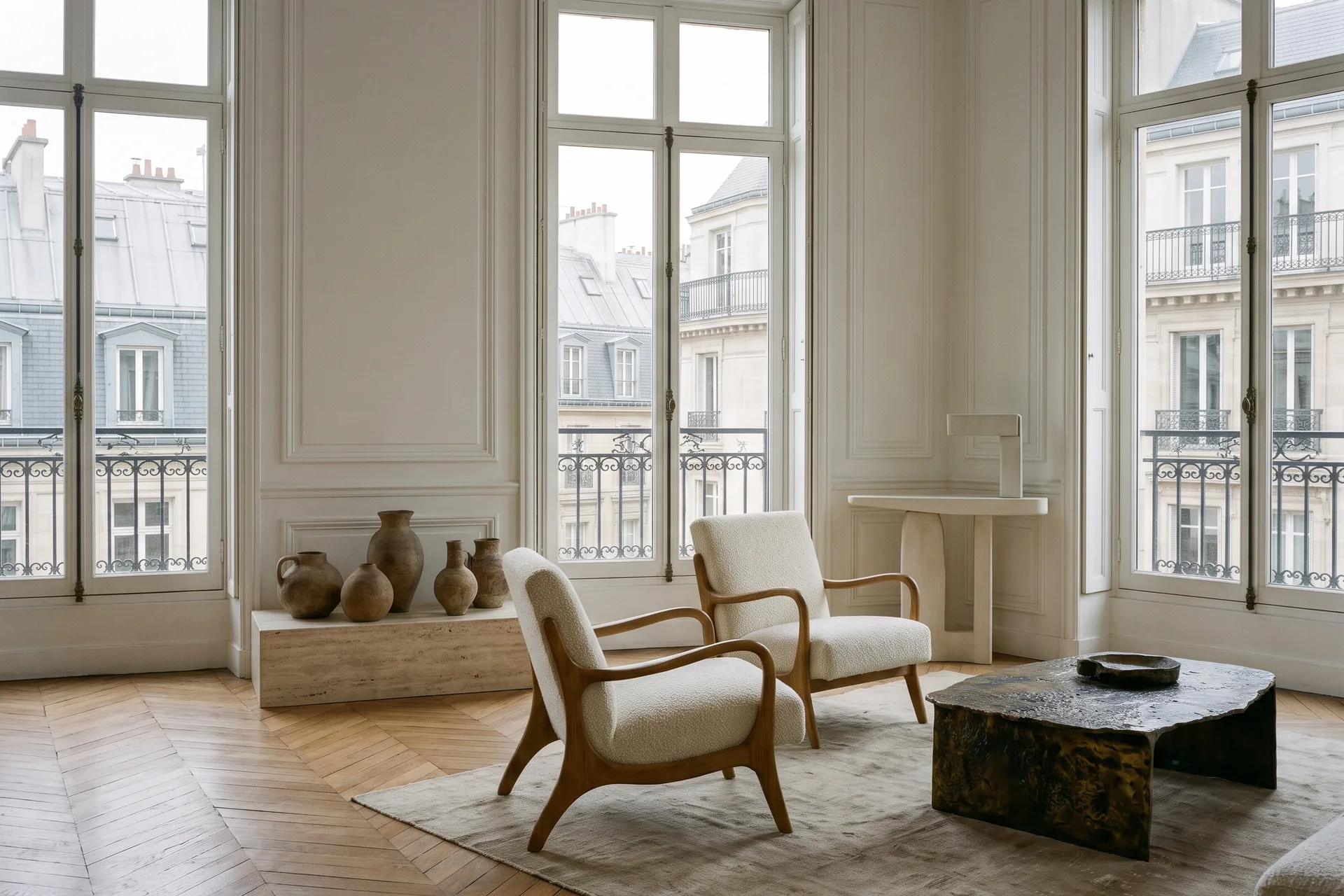
While the fair fills the halls outside the city, Paris Design Week brings design into the streets. Showrooms, galleries and studios across the city open their doors to show new work, often with exhibitions and installations. It is a chance to see furniture and objects in the setting of real Parisian rooms, with their parquet floors, tall windows and plaster mouldings.
The programme spreads over several neighbourhoods, each with its own character. Walking between them is part of the pleasure: a gallery opening here, a craftsman’s studio there, and a café terrace in between to look over your notes and decide where the afternoon should lead.
Many showrooms in Paris occupy former apartments, ateliers or shops, so a single street may hold rugs in a vaulted cellar, lamps on a first floor and furniture behind a carriage door. Seeing pieces in such rooms, at domestic scale and in daylight, makes it easy to imagine them in your own home.
The galleries of the Left Bank
The Left Bank, and especially the streets around Saint-Germain-des-Prés, has a long tradition of galleries devoted to twentieth-century and contemporary design. Within a few streets you can move from French furniture of the 1930s and 1940s to postwar lighting and ceramics and to contemporary pieces made in small studios, often presented in rooms composed like a collector’s apartment.
These galleries are places of knowledge as much as of trade. Gallerists are usually glad to talk about a maker, a period or a technique, to open a drawer or turn a lamp so you can see how it was made. Visiting them is one of the finest ways to train the eye.
Among the figures whose work you may meet there is Charlotte Perriand, who began her career in the late 1920s and went on to design furniture and interiors in steel, wood and bamboo, shaped by her years in Japan and her love of the mountains. Her clear and humane designs show how French modernism could be rigorous and warm at once.
In Paris, decoration is not an afterthought but a way of seeing.
A visit in two rhythms
Paris rewards a visitor who alternates the concentrated days of the fair with the slower days of the city:
- Separate fair days from city days
- Walk the gallery streets of the Left Bank slowly
- Spend a morning in the museum of decorative arts
- Note pieces, makers and periods as you go
- Return for a second look before deciding
The museum of decorative arts, in a wing of the Louvre palace, is an ideal place to begin. Its period rooms and collections trace French furniture and objects from the Middle Ages to the present, and an hour there gives context to everything you will see in the galleries. Afterwards, a walk through the Tuileries garden lets the impressions settle.
As evening comes, the gallery lights of the Left Bank glow against the darkening streets, and the city seems for a moment like one long, beautifully arranged room. That is the gift of Paris to anyone who loves interiors: the conviction that decoration, done with knowledge and care, is an art in its own right.
Questions and answers
What is Maison et Objet?
Maison et Objet is a large trade fair for decoration, furniture and interiors, held at the Paris Nord Villepinte exhibition centre north of Paris. Manufacturers, studios and craftspeople present furniture, lighting, textiles, tableware and objects, mainly to interior designers, architects, hoteliers and retailers looking for new collections.
Where are the design galleries in Paris?
The Left Bank, and especially the streets around Saint-Germain-des-Prés, has a long tradition of galleries for twentieth-century and contemporary design. Within a short walk you can see French furniture of the interwar years, postwar lighting and ceramics, and new pieces from small studios, often arranged like a collector’s home.
How did Art Deco get its name?
The name comes from the Exposition internationale des Arts décoratifs et industriels modernes, held in Paris in 1925. The exhibition presented a new and modern luxury in lacquer, glass, ironwork and rare woods, and the style it celebrated was later named Art Deco after it.
Terms in this article
- Maison et Objet
- A trade fair for decoration, furniture and interiors held at the Paris Nord Villepinte exhibition centre.
- Société des artistes décorateurs
- A Paris society founded in 1901 to promote the decorative arts and to present new work to the public.
- Rive Gauche
- The Left Bank of the Seine in Paris, home to the design galleries around Saint-Germain-des-Prés.
Filed underfairsparisgalleriesdecorationmuseums


