
Hall II, LightingGlass and bronze5 min read
The Chandelier, Rediscovered
From candlelit crystal to sculptural glass: choosing, sizing and hanging the most festive light in the room.
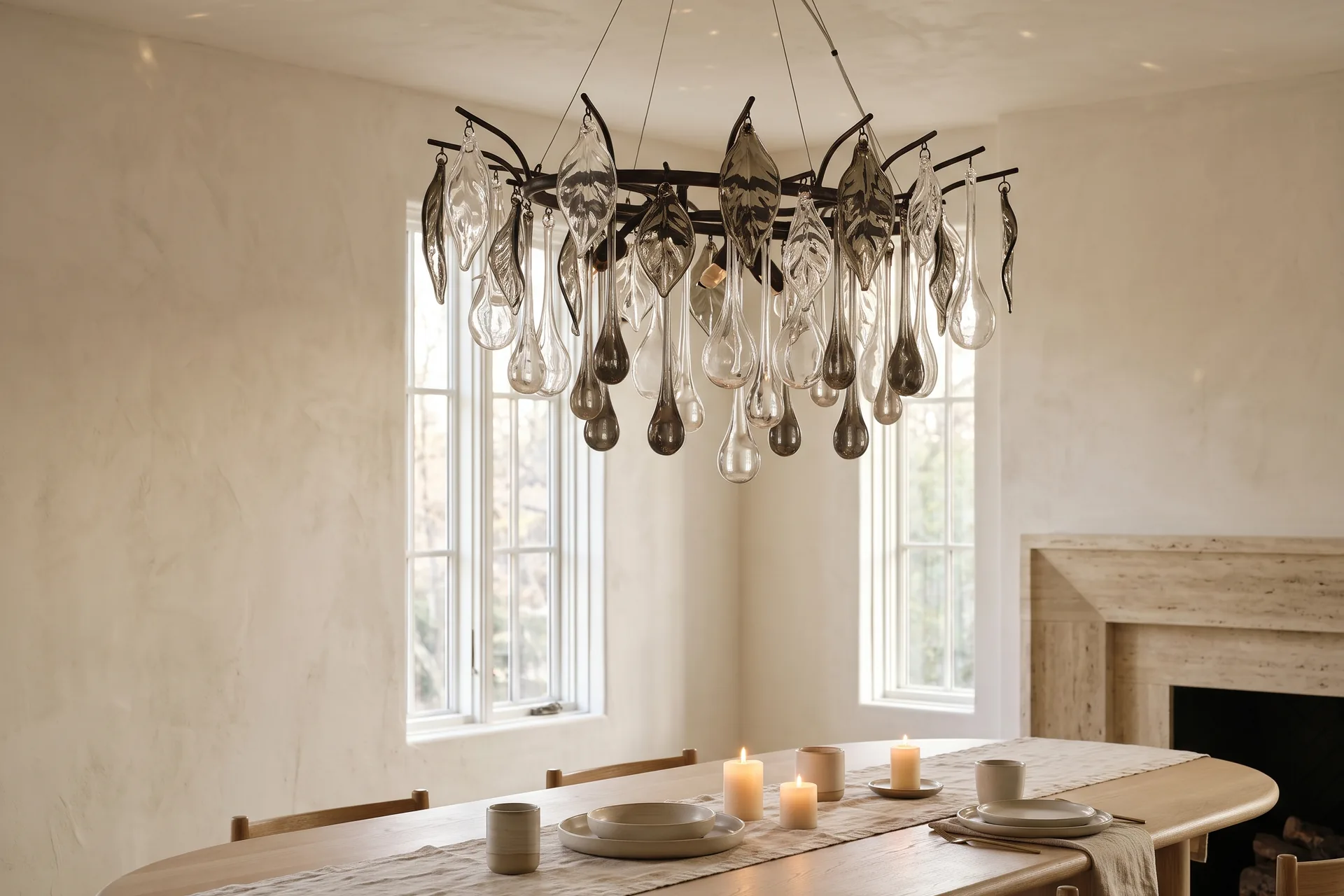
Evening settles over a dining room and a chandelier is brought up slowly on its dimmer. Light gathers in the glass, breaks into small reflections across the ceiling and comes to rest on the table below. No other fitting announces an occasion so quietly. This guide follows the chandelier from candlelit crystal to sculptural glass, then sets out the rules of thumb for its size, its height and its care.
At a glance
- Cut crystal drops were first hung to multiply candlelight in seventeenth and eighteenth-century rooms.
- Room length plus width in metres, times about 8, gives a chandelier diameter in centimetres.
- Over a table, choose half to two thirds of its width and hang 75 to 90 cm above.
- Keep about 210 cm clear height where people walk, and dim to a warm 2700 K.
From candlelight to glass
The chandelier began as a frame for candles. In the seventeenth and eighteenth centuries, cut crystal drops were hung around the candle arms to catch the flames and multiply them, so that a room lit by a few dozen candles seemed to shimmer. Every facet worked as a small prism, scattering points of light across walls, mirrors and gilded frames.
In Venice, the glassmakers of Murano developed a language of their own: blown glass, clear or coloured, drawn into leaves, flowers and curling arms. These chandeliers are light and playful, their glass shaped while hot rather than cut when cold. The Bohemian tradition, meanwhile, became renowned for cut crystal of great brilliance, and its glittering drops remain a reference for the classical chandelier.
The twentieth century reimagined the form. Art Deco pieces favoured stepped tiers and frosted glass set in bronze; mid-century designers drew chandeliers as constellations of brass arms and glass globes. Today, sculptural pieces in blown glass, alabaster, ceramic and patinated metal treat the chandelier as a work of art suspended in the air.
Choosing the right size
A chandelier in proportion looks inevitable; one too small seems timid, one too large crowds the ceiling. A few rules of thumb give a sound starting point.
- For a room: length plus width in metres, multiplied by about 8, gives the diameter in centimetres
- Over a dining table: about half to two thirds of the table width
- Above a table: the lowest point about 75 to 90 cm above the top
- Where people walk beneath: at least about 210 cm of clear height
The room rule is a metric version of an old imperial one, and it works well. A room of 5 by 4 m suggests a chandelier of roughly 70 to 75 cm across; a room of 7 by 6 m, about 105 to 110 cm. Tall rooms can carry a piece with more vertical presence, while lower rooms suit flatter, wider forms that stay close to the ceiling.
Over a dining table, the table sets the scale. For a top 100 cm wide, a diameter of roughly 50 to 65 cm keeps the chandelier generous without crowding the guests. Over a long table, an oval or linear chandelier, or a pair of smaller ones, follows the length of the top and spreads the light evenly.
Hanging height and fixing
Above a table, hang the lowest point about 75 to 90 cm above the top. The light then gathers over the table like a canopy, faces stay clear and guests can see one another across it. In a room with a very high ceiling, a longer drop brings the chandelier down into the space where people actually live.
Where people walk beneath, in a hall, a landing or a stairwell, keep at least about 210 cm of clear height below the lowest drop. In a double-height hall, a chandelier hung at the level of the upper floor can be admired from both storeys, and it greets visitors from the moment the door opens.
A chandelier is often heavier than it looks, and its fixing must carry the whole weight safely. An electrician checks the ceiling, fits a suitable hook or mounting plate and connects the wiring, so that the piece hangs straight and secure for decades.
Light that flatters
A dimmer is the chandelier’s best companion. Turned up, it lights a room for cleaning or for a party; turned low, it becomes a soft glow above the table while lamps and candles do the rest. Warm white of around 2700 K suits most chandeliers, gives crystal a golden sparkle and flatters skin, wood and linen.
For traditional pieces, candle-shaped lamps keep the original character of the arms, and clear lamps make crystal sparkle more than frosted ones. Choose lamps with good colour rendering, so that the colours of food, flowers and faces remain true even when the light is low.
The Lighting Planner treats the chandelier as one layer among several: it estimates the lumen a room needs, suggests a colour temperature and calculates a chandelier diameter from the dimensions of your room. A chandelier rarely lights a room alone, and it looks its best when it does not have to.
A chandelier does its finest work when it is dimmed almost to candlelight.
Keeping it bright
Regular, gentle dusting with a soft brush keeps glass clear and spares it a more thorough cleaning. Always switch off the light first and let the lamps cool, then work from the top downwards so that dust falls away from cleaned parts.
A crystal chandelier deserves a careful wash from time to time. Wear cotton gloves so that no fingerprints are left behind, and wipe each drop with a soft, lint-free cloth, working tier by tier. Very large or delicate pieces are best entrusted to a specialist, who can also check the wiring and the hooks.
Clean, dimmed and hung at the right height, a chandelier gives a room its centre and its sense of occasion. It turns an ordinary dinner into an evening, and when the lights are low, it still holds a little of the candlelight it was first made to multiply.
Tool02 Lighting Planner Room type and floor area in, lumen, colour temperature and a balanced mix of lights out. Open the toolQuestions and answers
What size chandelier suits my room?
Add the length and the width of the room in metres and multiply by about 8 for a diameter in centimetres. A room of 5 by 4 m suggests a chandelier of roughly 70 to 75 cm. Over a dining table, choose about half to two thirds of the table width instead.
How high should a chandelier hang above a dining table?
Hang the lowest point about 75 to 90 cm above the table top. The light then gathers over the table while faces and sightlines stay clear. Where people walk beneath a chandelier, in a hall or a stairwell, keep at least about 210 cm of clear height.
How do I clean a crystal chandelier?
Switch it off at the circuit and let the lamps cool. Wear cotton gloves to avoid fingerprints, then wipe each drop with a soft, lint-free cloth, working tier by tier. Photograph the arrangement first, and ask a specialist to clean very large or delicate pieces.
Terms in this article
- Crystal drop
- A single cut piece of glass or crystal hung from a chandelier to catch the light and scatter it as small reflections.
- Murano glass
- Blown glass from the island of Murano in the Venetian lagoon, shaped while hot into leaves, flowers and curling forms.
- Ceiling rose
- A decorative plate or moulding on the ceiling that covers the fixing and wiring of a hanging light.
Filed underlightingchandelierglasscrystaldining


